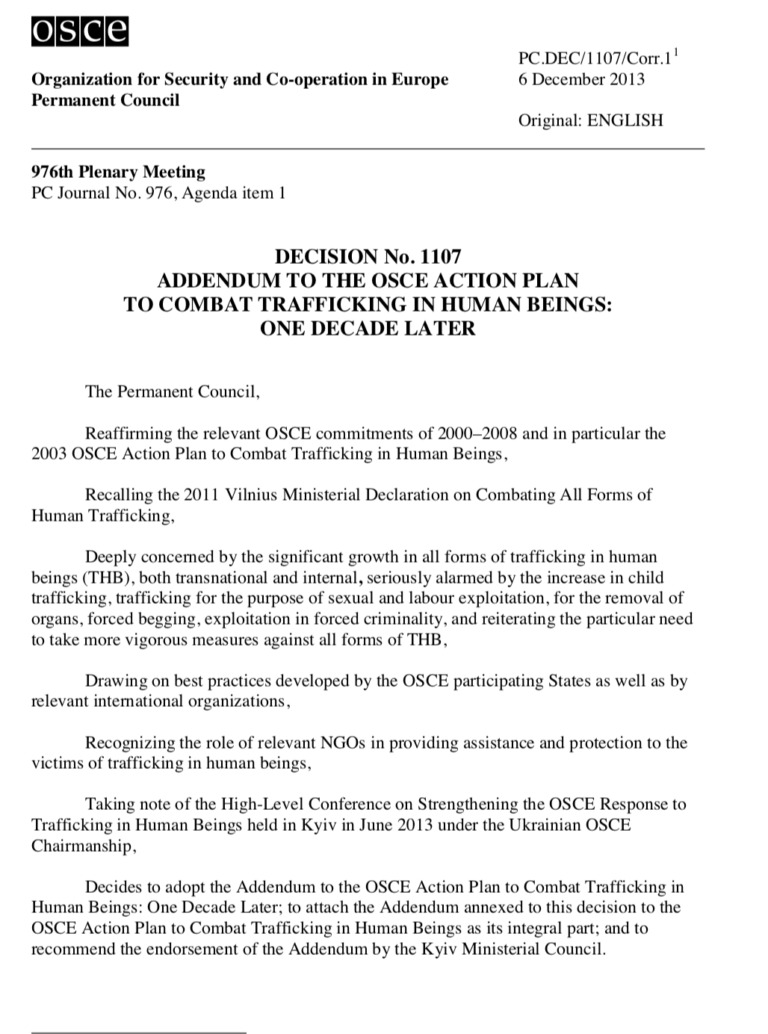
The Addendum complements the OSCE Action Plan to Combat Trafficking in Human Beings adopted in 2003 and supplemented in 2005, and provides the OSCE participating States with an updated toolkit to combat all forms of trafficking in human beings (THB). The Addendum helps to address the current and emerging THB trends and patterns, as well as the most pressing challenges related to the prosecution of the crime, its prevention, and protection of trafficked persons.

In its structure the Addendum follows the example of the Action Plan by addressing the “three Ps” (Prosecution, Prevention and Protection) in three separate sections. In addition, it is complemented by a new section on Partnerships.

With regards to prevention of THB in supply chains, the Addendum recommends to OSCE participating State to consider incorporating, or, as applicable, implementing, “zero-tolerance” policies or other similar standards in government procurement of goods and services and to encourage the private sector, trade unions and relevant civil society institutions, to promote codes of conduct to ensure the protection of the human rights and fundamental freedoms of workers throughout the supply chain in order to prevent the exploitative situations that foster trafficking in human beings.

Decision No. 1107 Addendum to the OSCE Action Plan to Combat Trafficking in Human Beings: One Decade Later - Organization for Security and Co-operation in Europe, 2013 DOWNLOAD

post

page

attachment

revision

nav_menu_item

custom_css

customize_changeset

oembed_cache

user_request

wp_block

wp_template

wp_template_part

wp_global_styles

wp_navigation

wp_font_family

wp_font_face

acf-taxonomy

acf-post-type

acf-field-group

acf-field

ai1ec_event

exactmetrics_note

National Hotline 2017 Utah State Report
Graphics & InfographicsPublications

The data in this report represents signals and cases from January 1, 2017 through December 31, 2017 and is accurate as of July 11, 2018. Cases of trafficking may be ongoing or new information may be revealed to the National Hotline over time. Conseq...Read More

The Counter-Trafficking Apparatus in Action: Who Benefits From It?
Publications

Based on long-term ethnographic research, including documentary research, qualitative interviews and observations made at a Portuguese shelter for “sex trafficked women,” this paper explores the counter-trafficking apparatus questioning who bene...Read More

TAGS: Europe
What’s changed for Syrian refugees in Turkish garment supply chains?
GuidancePublications

An estimated 650,000 Syrian refugees have fled their home country to escape bloodshed and have found a lifeline working in Turkey, with many working in the garment industry. Without these jobs, many families would face desperate times and would stru...Read More

Lived Realities of Sustained Liberation for Survivors of Trafficking in Addis Ababa, Ethiopia
News & AnalysisPublications

Many women and girls in Ethiopia work as domestic workers in urban cities as well as abroad, particularly in the Middle East. The conditions faced by women and girls in domestic work are well documented (see Freedom Fund 2019 and Tayah & Atnafu ...Read More