
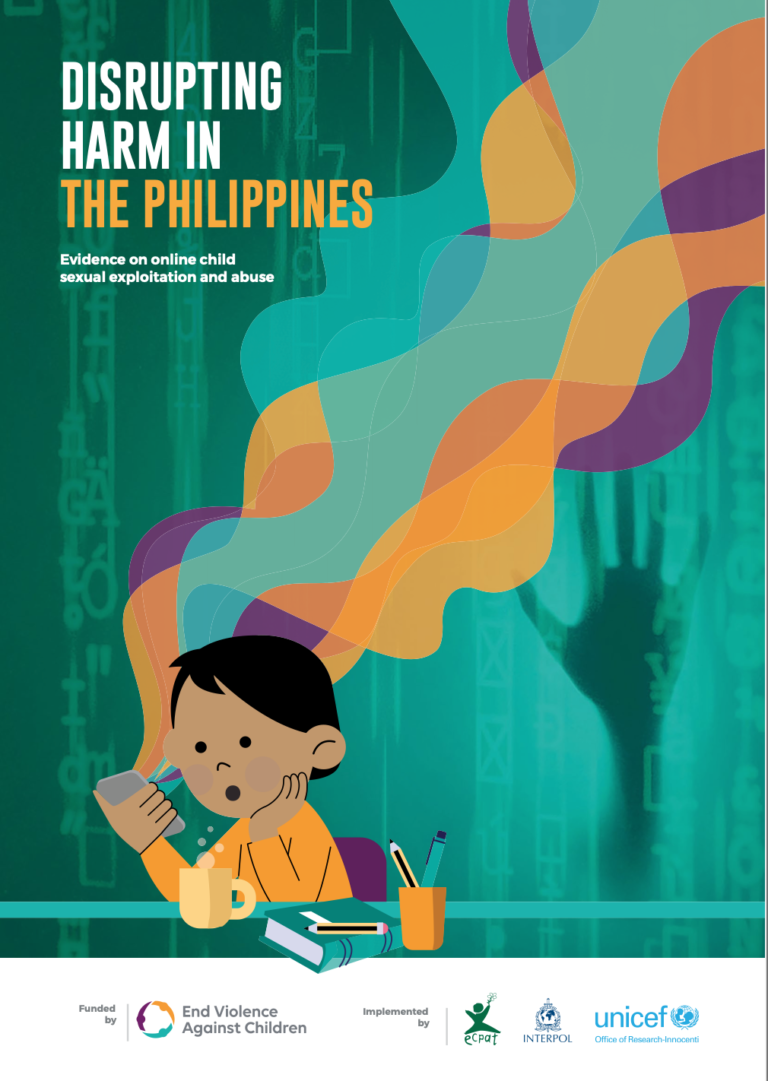
Funded by the Global Partnership to End Violence against Children through its Safe Online initiative, ECPAT, INTERPOL and UNICEF Office of Research – Innocenti worked in partnership to design and implement Disrupting Harm – a research project on online child sexual exploitation and abuse (OCSEA). This unique partnership brings a multidisciplinary approach to a complex issue to examine multiple facets of the problem. The research was conducted in seven Eastern and Southern African countries and six Southeast Asian countries including the Philippines. Data is synthesised from nine different research activities to generate each national report which tells the story of the threat and presents clear recommendations for action.

Disrupting Harm in The Philippines: Evidence on online sexual exploitation and abuse - ECPAT, INTERPOL, and UNICEF, 2022 DOWNLOAD

post

page

attachment

revision

nav_menu_item

custom_css

customize_changeset

oembed_cache

user_request

wp_block

wp_template

wp_template_part

wp_global_styles

wp_navigation

wp_font_family

wp_font_face

acf-taxonomy

acf-post-type

acf-field-group

acf-field

ai1ec_event

exactmetrics_note

Migrants and Their Vulnerability to Human Trafficking, Modern Slavery and Forced Labour
Guidance

Research suggests connections exist between migration and criminal forms of exploitation such as human trafficking, forced labour and modern slavery. Certainly, constellations of risk are seen in certain migrant communities and migration corridors. ...Read More

TAGS: Global
Debt Bondage in a Criminal Exploitation and County Lines Context: A Support Resource for Professionals
Guidance

Whilst this guidance is focused on debt bondage within a Criminal Exploitation and County Lines Context, this is a method of control well documented in other forms of exploitation including international trafficking and sexual exploitation. Therefor...Read More

TAGS: Global
Prevalence Estimate: Forced Labor Among Kenyan Workers in the Gulf Cooperation Council
Guidance

The Global Fund to End Modern Slavery (GFEMS) aims to end modern slavery by making it economically unprofitable through interventions and experimental innovations implemented in collaboration with on-the-ground partners. With support from the U.S. D...Read More

Analysing Modern Slavery Risks in Portfolio Companies: Guidance for Investors
Guidance

As a result of the progressive legalization of international business and human rights “soft law” standards, the “S” of “ESG” is no longer an optional criterion for investors to include in their decision-making process, but it is becomin...Read More