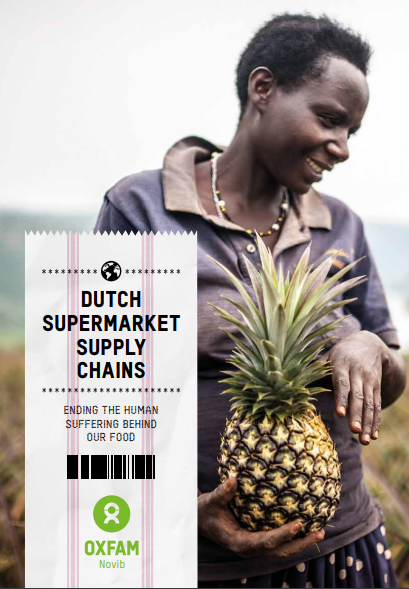
Inequality is rampant across the global economy, and the agro-food sector is no exception. At the top, big supermarkets and other corporate food giants dominate global food markets, allowing them to squeeze value from vast supply chains that span the globe, while at the bottom the bargaining power of small-scale farmers and workers has been steadily eroded in many of the countries from which Dutch supermarkets and others from around the world source. The result is widespread human suffering among the women and men producing our food.

This report and Dutch summary put key findings of the global campaign report Ripe for Change: Ending human suffering in supermarket supply chains in a Dutch context.

Dutch Supermarket Supply Chains: Ending the human suffering behind our food - Oxfam Novib, 2018 DOWNLOAD

post

page

attachment

revision

nav_menu_item

custom_css

customize_changeset

oembed_cache

user_request

wp_block

wp_template

wp_template_part

wp_global_styles

wp_navigation

wp_font_family

wp_font_face

acf-taxonomy

acf-post-type

acf-field-group

acf-field

ai1ec_event

exactmetrics_note

Supply Chain Risk Report: Child and forced labour in Canadian consumer products
Publications

The report looks at Canada’s connection to the issues of human trafficking and forced and child labour, by cross-referencing recent data on Canadian imports with the U.S. Department of Labour’s List of Goods Produced by Child Labour or Forced Lab...Read More

Reclaiming Migrant Women’s Narratives: A Feminist Participatory Action Research Project on ‘Safe and Fair’ Migration in Asia
Publications

The report shows that Safe and Fair migration cannot happen in a silo – the factors that produce gender segregated labour markets, industries dependent on flexible, underpaid and overworked migrant labour require a systemic change. This change can...Read More

TAGS:
Ending child labour, forced labour and human trafficking in global supply chains
Publications

The report aims to presents research findings and recommendations on child labour, forced labour and human trafficking in global supply chains. Jointly authored by the ILO, OECD, IOM and UNICEF under the aegis of Alliance 8.7, the report also repres...Read More

How Companies can deal with Labour Exploitation in the Agricultural Sector
Publications

Abstract This short paper tends to shed light and reflect on the way forward for companies to address labour exploitation in their agricultural supply chain. For that, it will first refer to some of the cases reported in Spain and Italy to then br...Read More