
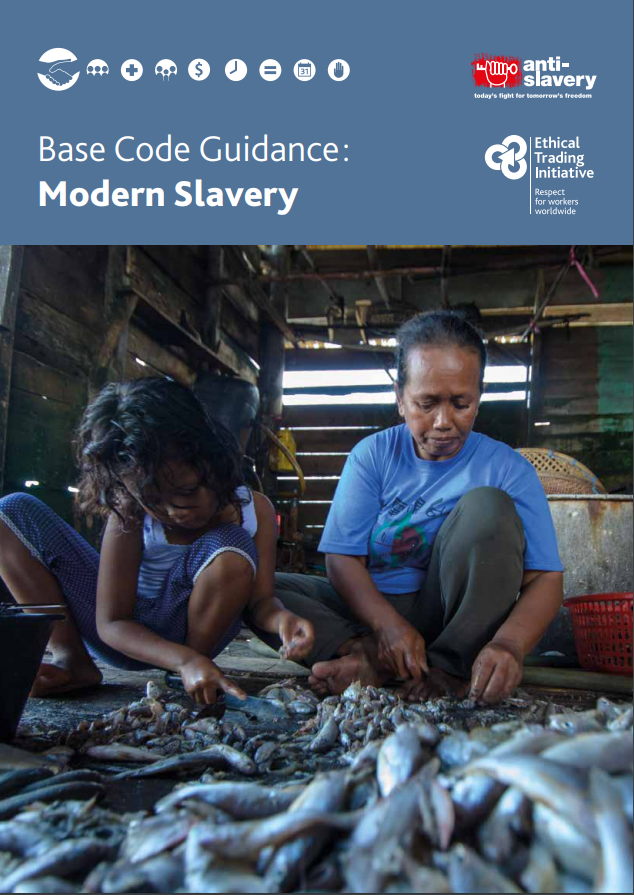
This guide developed by Ethical Trade Initiative (ETI) will help businesses understand key concepts, legal definitions and their responsibility to tackle modern slavery. It provides examples and practical steps to assist companies in applying ETI Base Code clauses.

child labour

ETI's Base Code Guidance: Modern slavery - practical guidance for brands and retailers - Ethical Trade Initiative (ETI), 2017 DOWNLOAD

post

page

attachment

revision

nav_menu_item

custom_css

customize_changeset

oembed_cache

user_request

wp_block

wp_template

wp_template_part

wp_global_styles

wp_navigation

wp_font_family

wp_font_face

acf-taxonomy

acf-post-type

acf-field-group

acf-field

ai1ec_event

exactmetrics_note

Handbook on Initial Victim Identification and Assistance for Trafficked Persons
Guidance

The Task Force, which was established in 2016, is a multidisciplinary and cooperative consortium of 27 organizations with the mission to collectively advance anti-trafficking efforts in the Hong Kong SAR. The Handbook’s release follows the endorsem...Read More

Review of law, policy and practice of recruitment of migrant workers in Pakistan
Guidance

This review provides an overview of legislative and policy frameworks concerning the recruitment of migrant workers in Pakistan. The review identifies gaps in relation to the ILO General Principles and Operational Guidelines for Fair Recruitment, an...Read More

Barriers and opportunities for more effective identification of victims of human trafficking: Insights from Bangladesh, Cambodia, and Taiwan
Guidance

This research has been carried out by the Institute of Development Studies (IDS) and Humanity Research Consultancy (HRC) in partnership with Winrock International, funded by USAID. It builds on earlier research on Trafficking in Persons su...Read More

Best practice guidance on ethical recruitment of migrant workers: Executive summary
Guidance

Almost 21 million people (a conservative estimate) are trapped in conditions of forced labor that generates over $150 billion in profits for other parties. Of these workers, over 75% are exploited within the traditional private sector, esp...Read More