When:
June 29, 2017 – June 30, 2017 all-day
2017-06-29T00:00:00+02:00
2017-07-01T00:00:00+02:00
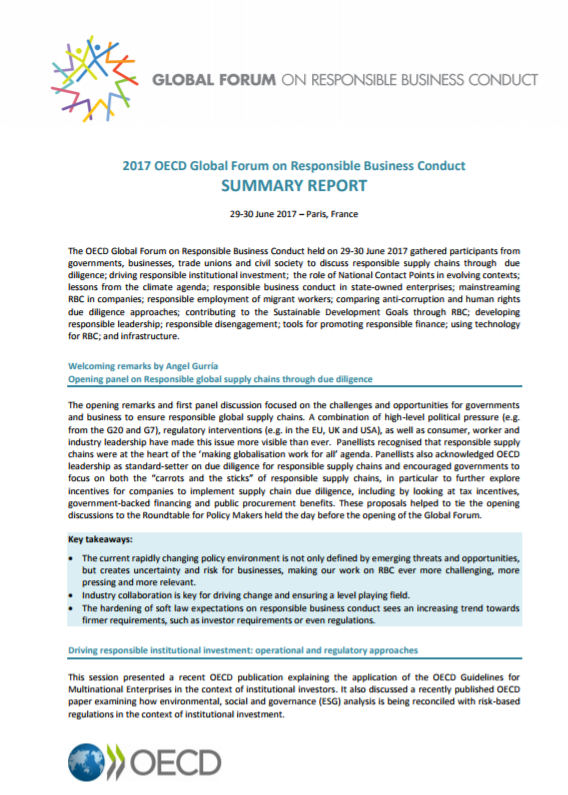
2017 OECD Global Forum on Responsible Business Conduct SUMMARY REPORT

The OECD Global Forum on Responsible Business Conduct held on 29-30 June 2017 gathered participants from governments, businesses, trade unions and civil society to discuss responsible supply chains through due diligence; driving responsible institutional investment; the role of National Contact Points in evolving contexts; lessons from the climate agenda; responsible business conduct in state-owned enterprises; mainstreaming RBC in companies; responsible employment of migrant workers; comparing anti-corruption and human rights due diligence approaches; contributing to the Sustainable Development Goals through RBC; developing responsible leadership; responsible disengagement; tools for promoting responsible finance; using technology for RBC; and infrastructure. 

2017 OECD Global Forum on Responsible Business Conduct - Summary Report DOWNLOAD

post

page

attachment

revision

nav_menu_item

custom_css

customize_changeset

oembed_cache

user_request

wp_block

wp_template

wp_template_part

wp_global_styles

wp_navigation

wp_font_family

wp_font_face

acf-taxonomy

acf-post-type

acf-field-group

acf-field

ai1ec_event

exactmetrics_note

Child Labour Platform: Recommendations for companies
Publications

This compilation includes examples of approaches that multiple companies in the textile and garments, cocoa, tourism and/or mining sectors have adopted to prevent and remediate child labour. These examples were identified on the basis of informati...Read More

From Labour of Love to Decent Work: Protecting the Human Rights of Migrant Caregivers in Canada
Publications

This article examines Canada’s federal Live-in Caregiver Program (LCP) from the perspective of international human-rights and labour norms pertaining to the protection of migrant workers. Showing that the current legal framework of the LCP restric...Read More

On exploitation, agency and child domestic work: evidence fromSouth-West Nigeria
Publications

The engagement of children in domestic work in third-party households is mostly conceived as a decision that benefits adult actors – employers, intermediaries and/or parents – at the expense of young people. Thus, child domestic workers are ...Read More

TAGS:
2018 Food and Beverage Benchmark Findings Report
Publications

Executive Summary The risk of forced labour is pervasive across today’s food and beverage supply chains: from tea pickers on tea estates to crew members on fishing vessels and labourers on cattle and poultry ranches, cocoa farms, and rice mills. ...Read More