
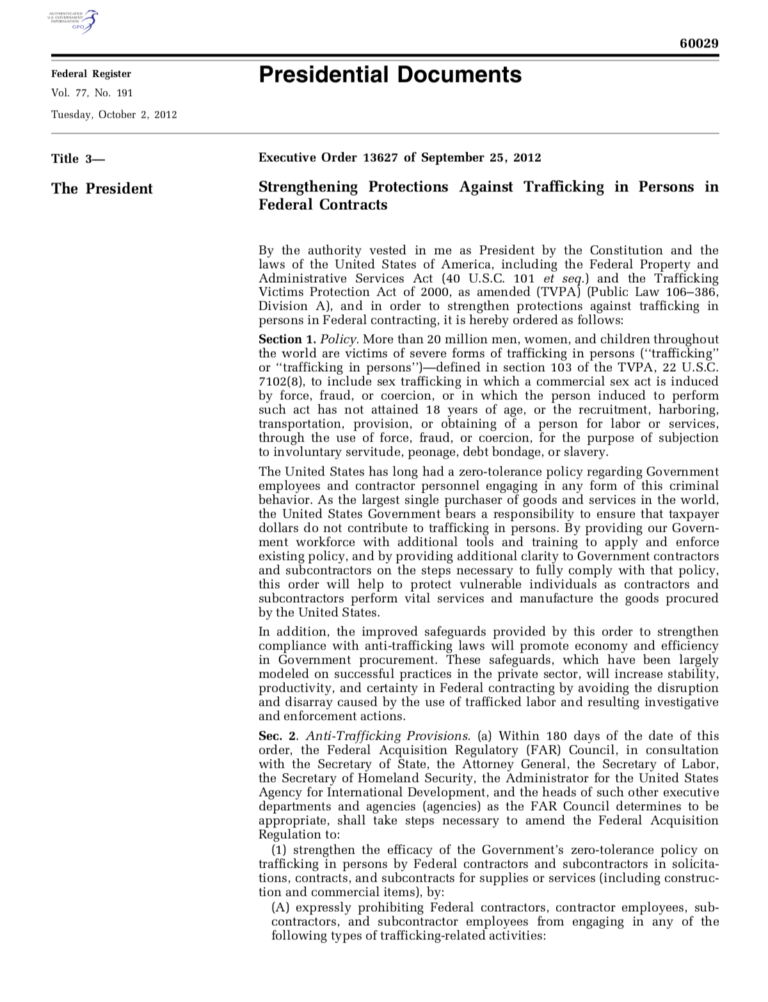
The United States has long had a zero-tolerance policy regarding Government employees and contractor personnel engaging in any form of this criminal behavior. As the largest single purchaser of goods and services in the world, the United States Government bears a responsibility to ensure that taxpayer dollars do not contribute to trafficking in persons. By providing our Government workforce with additional tools and training to apply and enforce existing policy, and by providing additional clarity to Government contractors and subcontractors on the steps necessary to fully comply with that policy, this order will help to protect vulnerable individuals as contractors and subcontractors perform vital services and manufacture the goods procured by the United States.

In addition, the improved safeguards provided by this order to strengthen compliance with anti-trafficking laws will promote economy and efficiency in Government procurement. These safeguards, which have been largely modeled on successful practices in the private sector, will increase stability, productivity, and certainty in Federal contracting by avoiding the disruption and disarray caused by the use of trafficked labour and resulting investigative and enforcement actions.

Executive Order - Strengthening Protections Against Trafficking In Persons In Federal Contracts - United States, 2012 DOWNLOAD

post

page

attachment

revision

nav_menu_item

custom_css

customize_changeset

oembed_cache

user_request

wp_block

wp_template

wp_template_part

wp_global_styles

wp_navigation

wp_font_family

wp_font_face

acf-taxonomy

acf-post-type

acf-field-group

acf-field

ai1ec_event

exactmetrics_note

Antislavery in Domestic Legislation Country Reports
Standards & Codes of ConductGood PracticesLegislationPublications

Research and analysis conducted by Katarina Schwarz (University of Nottingham) and Jean Allain (Monash University). To assess the extent to which slavery and related forms of human exploitation have been prohibited in domestic law, this project ...Read More

TAGS: Global
Legislating against Modern Slavery, Human Trafficking and Forced Labour: The Role of Parliament to Scrutinise & Raise Awareness
GuidanceLegislation

The e-Handbook: Legislating against Modern Slavery, Human Trafficking & Forced Labour is a comprehensive guide for parliamentarians and parliamentary officials on legislating effectively against modern slavery related crimes. One in 200 p...Read More

The Impact of Covid-19 on Modern Slavery and Child labour: How can lawyers make a difference? – International Bar Association
COVID-19 resourcesLegislationWebinars

According to the 2017 Global Estimates of Modern Slavery published by Alliance 8.7, 40.3 million people were estimated to be victim of modern slavery in 2016. Modern slavery is not defined in law and it is used as an umbrella term to refer to ‘sit...Read More

TAGS: Global
Independent Anti-Slavery Commissioner Annual Report 2020-2021
GuidanceLegislationPublications

In March 2020 Delta 8.7 published an article which argued that the pandemic would impact on modern slavery in at least three ways: by heightening risks for those already exploited, increasing he risks of exploitation and disrupting response efforts....Read More

TAGS: Europe