
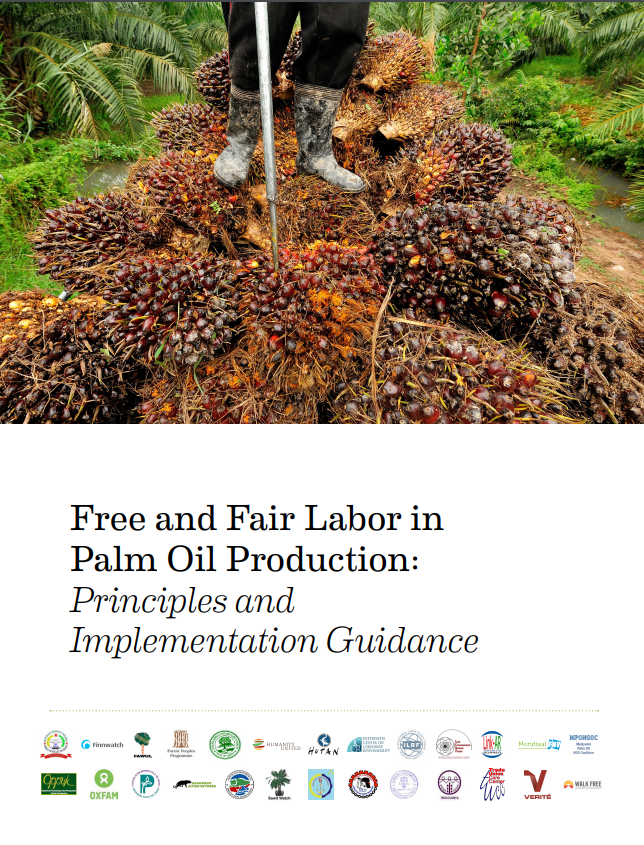
The Free and Fair Labor Principles (“Principles”) and corresponding Implementation Guidance (“Guidance”) is intended to support and advance the ongoing dialogue on responsible palm oil by providing a common point of reference on what constitutes free and fair labour in palm oil production.

It is based on the frameworks enshrined in International Labor Organization core conventions and the UN Guiding Principles on Business and Human Rights, and it builds on the existing standard established by the Roundtable on Sustainable Palm Oil (RSPO). It is not intended as a new code of conduct or certifiable standard, but rather as a resource to provide concrete and practical guidance on implementing responsible palm oil production.

Free and Fair Labor in Palm Oil Production: Principles and Implementation Guidance - Humanity United, 2015 DOWNLOAD

post

page

attachment

revision

nav_menu_item

custom_css

customize_changeset

oembed_cache

user_request

wp_block

wp_template

wp_template_part

wp_global_styles

wp_navigation

wp_font_family

wp_font_face

acf-taxonomy

acf-post-type

acf-field-group

acf-field

ai1ec_event

exactmetrics_note

Recovery and Reintegration of Trafficking Victims: A Practitioner Guide
Guidance

This Practitioner Guide presents existing research and evidence on the recovery and reintegration of trafficking victims, including challenges faced and practices that can be mobilized to enhance reintegration outcomes. It is part of the NEXUS/RSO P...Read More

Preventing modern slavery & human trafficking: An agenda for action across the financial services sector
GuidancePublications

There are over 40 million people in modern slavery worldwide. Modern slavery exists in every industry, in every country in the world. The financial services industry has a major role to play in combating this violent and abusive business. And yet th...Read More

From Policies to Impacts: Analysing Modern Slavery Risks in Portfolio Companies
Guidance

As a result of the progressive legalization of international business and human rights “soft law” standards, the “S” of “ESG” is no longer an optional criterion for investors to include in their decision-making process, but it is becom...Read More

What works to end modern slavery? A review of evidence on policy and interventions in the context of justice
GuidancePublications

The purposes of the study was to examine what is known about effective policy to achieve SDG Target 8.7 in the context of justice, by: (1) collecting and collating existing evidence on what works; (2) identifying the range of claims and hypotheses c...Read More