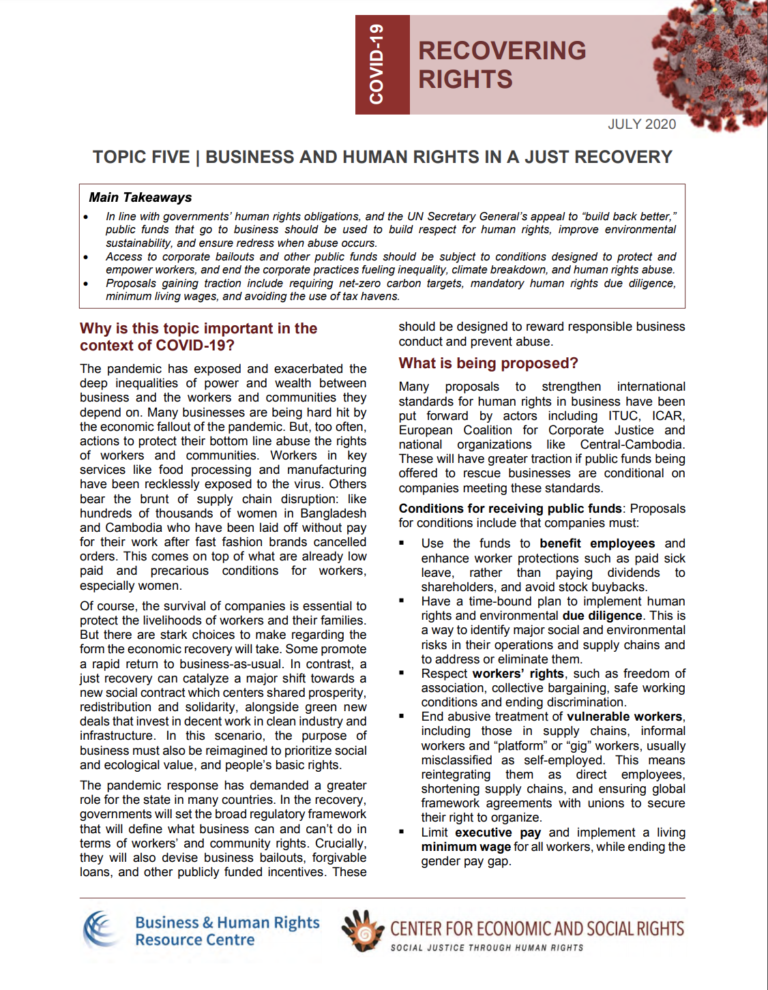
This brief is part of a series highlighting how we can leverage the commitments governments have made to guarantee human rights to steer us towards a just recovery from the COVID-19 pandemic.

The pandemic response has demanded a greater role for the state in many countries. In the recovery, governments will set the broad regulatory framework that will define what business can and can’t do in terms of workers’ and community rights. Crucially, they will also devise business bailouts, forgivable loans, and other publicly funded incentives. These should be designed to reward responsible business conduct and prevent abuse.

This brief focuses on the protection and strengthening of international standards for human rights in businesses in the process of recovery of those businesses seriously affected by the Covid-19 pandemic. The brief suggests a series of conditions companies should meet in order to receive public funds, as well as a range of accompanying measures that can enhance the transformative potential of bailout conditions.

Recovering Rights Series: Business and Human Rights in a Just Recovery - Business & Human Rights Resource Centre and Center for Economic and Social Rights, 2020 DOWNLOAD

post

page

attachment

revision

nav_menu_item

custom_css

customize_changeset

oembed_cache

user_request

wp_block

wp_template

wp_template_part

wp_global_styles

wp_navigation

wp_font_family

wp_font_face

acf-taxonomy

acf-post-type

acf-field-group

acf-field

ai1ec_event

exactmetrics_note

IOM Handbook: Protection and Assistance for Migrants Vulnerable to Violence, Exploitation and Abuse
Guidance

This Handbook is intended for case managers, service providers, communities, development entities and States working to provide protection and assistance to migrants vulnerable to violence, exploitation and abuse, or to mitigate and reduce factors c...Read More

TAGS:
Global Guidelines on the Prevention of Forced Labour Through Lifelong Learning and Skills Development Approaches
GuidanceStandards & Codes of Conduct

Quality education and training lays the foundation for the economic and social development not only of individuals but of society as a whole. Yet, many lack opportunities to acquire relevant knowledge and skills that would allow them to earn a decen...Read More

Using Worker Voice Tools to Assess Relationships Between Workers and their Managers
Guidance

This note focuses on one dimension of how technology-enabled worker voice tools can be used: to gather qualitative data about the nature of relationships between managers and workers or communities at factories, farms, mines, and plantations. This i...Read More

Improving accountability and access to remedy for victims of business-related human rights abuse through non-State-based grievance mechanisms
Guidance

The present report sets out recommended action to improve accountability and access to remedy for victims of business-related human rights abuses through non-Statebased grievance mechanisms. It has been compiled as part of the Accountability and Rem...Read More