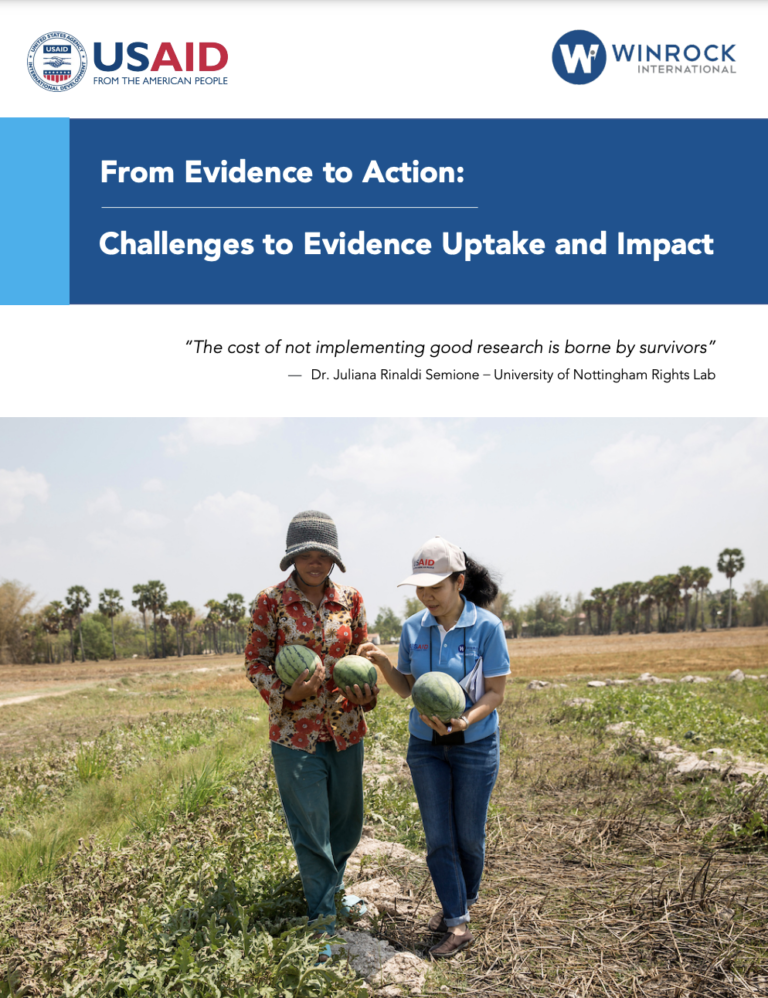
On 10-12 November 2020, the USAID Asia Counter-Trafficking in Persons project hosted the 2020 CTIP Evidence Summit, “From Evidence to Action”, which included the two Summit discussions “Barriers to Evidence Uptake — Civil Society Organization (CSO) perspectives” and “Cultural and Logistical Barriers to Research and Dissemination”.

The discussions during these two Summit sessions revealed several common barriers to evidence uptake, mostly shared from the perspectives of project implementers. This brief synthesizes the two sessions and distills the key themes that emerged, reflecting attendees’ recurring concerns and values. Listed in alphabetical order, the most frequently discussed barriers to evidence uptake were challenges around access, collaboration, engaging funders, ethics or approval processes, feasibility, funding, relevance, time, and understanding. In addition, to these key themes, two identified needs from the participants were knowledge consolidation and strategy unification. This brief examines each of those themes and needs, as well as some of the solutions proposed by attendees.

From Evidence to Action: Challenges to Evidence Uptake and Impact - Winrock International, 2021 DOWNLOAD

post

page

attachment

revision

nav_menu_item

custom_css

customize_changeset

oembed_cache

user_request

wp_block

wp_template

wp_template_part

wp_global_styles

wp_navigation

wp_font_family

wp_font_face

acf-taxonomy

acf-post-type

acf-field-group

acf-field

ai1ec_event

exactmetrics_note

National Hotline 2018 Tennessee State Report
Graphics & InfographicsPublications

The data in this report represents signals and cases from January 1, 2018 through December 31, 2018 and is accurate as of July 25, 2019. Cases of trafficking may be ongoing or new information may revealed to the National Hotline over time. Consequen...Read More

Supermarket Responsibilities for Supply Chain Workers’ Rights – Continuing Challenges in Seafood Supply Chains and the Case for Stronger Supermarket Action
Publications

International food supply chains provide employment for tens of millions of women and men around the world, demonstrating the potential for private sector actors to fight poverty and inequality. Yet far too many work in appalling conditions. The o...Read More

Aggravating circumstances: How coronavirus impacts human trafficking
COVID-19 resourcesNews & AnalysisGuidanceGraphics & InfographicsPublications

Authors: Livia Wagner, Thi Hoang The policy brief was originally posted here on GI-TOC website, as part of its #CovidCrimeWatch initiative. The coronavirus is not only claiming hundreds of thousands of lives, but is also causing a global econo...Read More

TAGS: Global
Labour Inspection and Monitoring of Recruitment of Migrant Workers: Technical Brief
GuidancePublications

Labour migration may benefit employers and workers, and across the world recruitment agencies play an important role in matching migrant workers with available jobs. However, while the cost of recruitment of higher skilled migrant workers tends to b...Read More

TAGS: Global