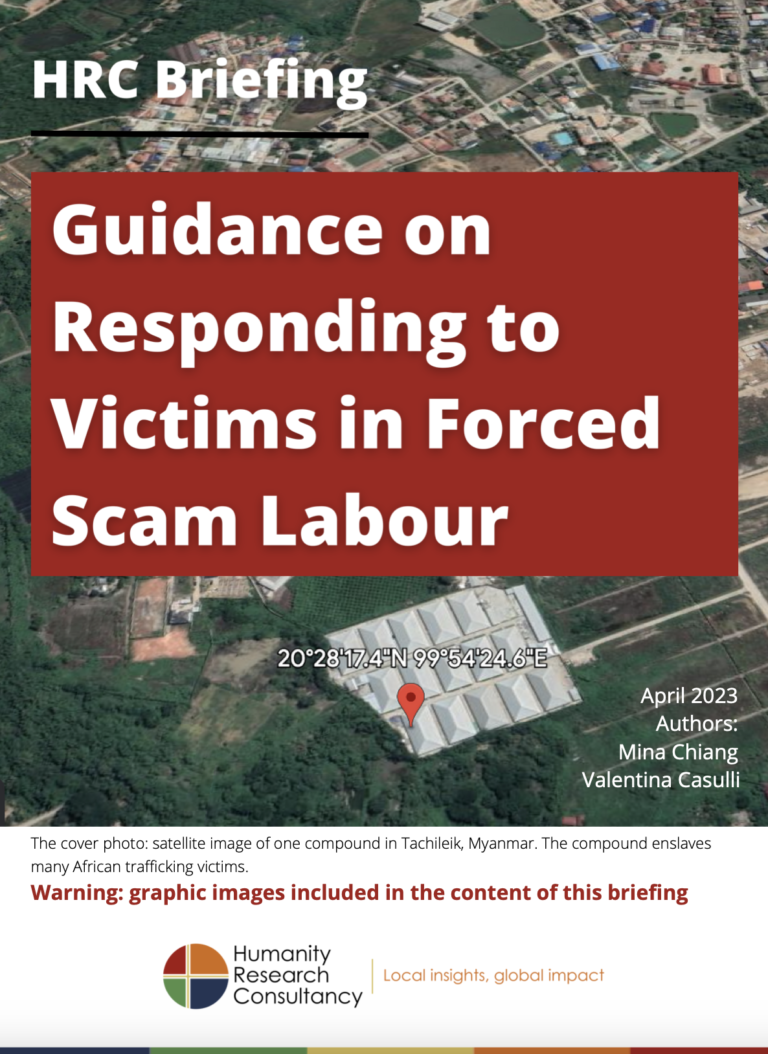
In September 2022, HRC published a briefing addressing the emerging organised crime of victims systematically trafficked to scamming compounds in Southeast Asia. The briefing led to many inquiries from journalists and a subsequent growth in media coverage to raise awareness. We are pleased to see that increased international attention places pressure on governments to take action to address the crime, notably the Taiwanese government, the Cambodian government, and more.

Since September 2022, whilst HRC has continued supporting victims and survivors together with our partners, we have prioritised influencing key stakeholders for systemic change. This briefing shares our latest analysis and suggestions on addressing this form of modern slavery. A stronger global focus on this issue is needed to lead to more crucial actions from the UN bodies, national governments, non-governmental organisations, and human rights activists.

Guidance on responding to victims in forced scam labour - Humanity Research Consultancy, 2023 DOWNLOAD

post

page

attachment

revision

nav_menu_item

custom_css

customize_changeset

oembed_cache

user_request

wp_block

wp_template

wp_template_part

wp_global_styles

wp_navigation

wp_font_family

wp_font_face

acf-taxonomy

acf-post-type

acf-field-group

acf-field

ai1ec_event

exactmetrics_note

International Labor Migration: The Responsible Role of Business – BSR, 2008
GuidanceStandards & Codes of ConductGood Practices

In today’s globalized economy, the issue of international labor migration in supply chains is one of the most critical – yet largely unexplored – issues for our member companies and all businesses operating globally. Labor migrants now repr...Read More

Resource: Law and Policy Compendium on Commercial Sexual Exploitation (CSE) in Bangladesh and India
Guidance

The compendium provides an overview of legislative and policy frameworks on rehabilitation and reintegration in India and Bangladesh for CSE practitioners and stakeholders working to support justice, protection, and trauma-informed minimum standards...Read More

Towards safer recruitment of Ethiopian women into domestic work abroad: Early findings from the Meneschachin ‘Our Departure’ qualitative study
Guidance

This report presents preliminary findings from the first phase of data collection of the Meneshachin ‘Our Departure’ qualitative study (August 2020-May 2021) conducted by the London School of Hygiene and Tropical Medicine (LSHTM) in collabo...Read More

From Vulnerability to Resilience: Sex Workers Organising to End Exploitation
Guidance

Sex workers globally organize, unionize and develop initiatives to protect themselves from violence, exploitation, and human rights violations. They share strategies of how to work independently, where to work and how to keep themselves safe. Many s...Read More