
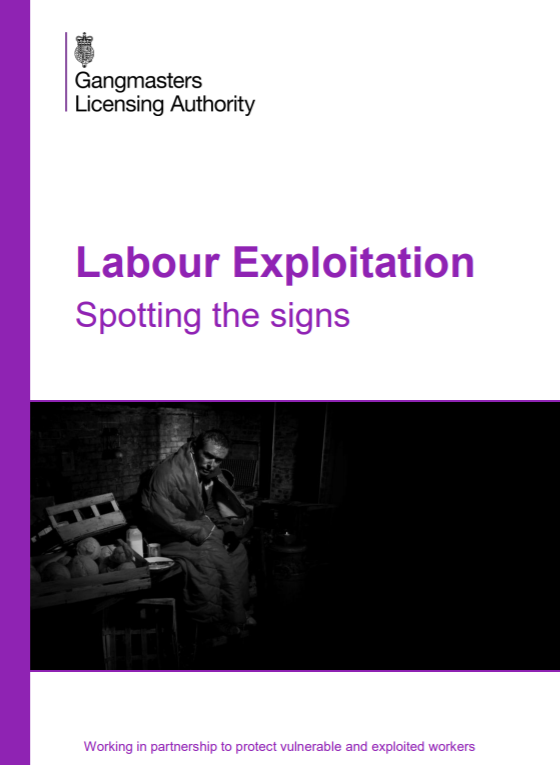
This guidance has been produced for use within the industry sectors regulated by the GLA. It can also be used as a reference to assist anyone who comes into contact with individuals who may have been trafficked and/or are being exploited by people who wish to control their movements and actions to exploit them for their labour.

post

page

attachment

revision

nav_menu_item

custom_css

customize_changeset

oembed_cache

user_request

wp_block

wp_template

wp_template_part

wp_global_styles

wp_navigation

wp_font_family

wp_font_face

acf-taxonomy

acf-post-type

acf-field-group

acf-field

ai1ec_event

exactmetrics_note

Implementation of the Non-Punishment Principle
Guidance

In the report, the Special Rapporteur analyses current challenges in the implementation of the principle of non-punishment. The principle of non-punishment constitutes the cornerstone of an effective protection of the rights of victims of traffickin...Read More

Reducing Modern Slavery
Guidance

Committee of Public Accounts, Thirty-Sixth Report of Session 2017–19 Modern slavery encompasses slavery, servitude and compulsory labour and human trafficking. In 2014 the UK Home Office (the Department) estimated that there were between 10,000...Read More

Combating trafficking in human beings and labour exploitation in supply chains: Guidance for OSCE Procurement
Guidance

When moving towards mitigating or ultimately preventing trafficking in human beings and labour exploitation (THB/LE) in supply chains, a wider perspective is needed, one that includes human rights and decent working conditions. THB/LE is the extreme...Read More

Trafficking in Human Beings – Organised Ritual Abuse
Guidance

Trafficking in human beings is defined as a set of circumstances whereby a person is pushed into an exploitative situation by an individual or individuals taking advantage of their plight. This can manifest itself in various forms and occur in diffe...Read More

TAGS: Europe