
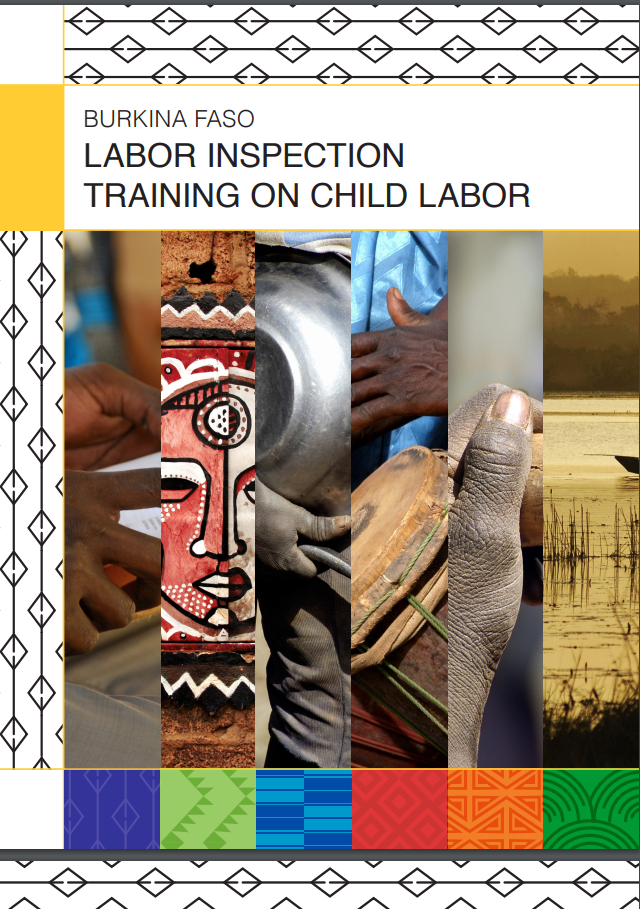
This facilitator’s guide provides tips and advice to help facilitators successfully use the curriculum for Labour Inspection Training on Child Labour in Belize.

It describes the purpose and objectives of the training; provides an overview of the training structure and format; gives examples of icebreakers and energizers; and includes sample training agendas and course evaluations.

The curriculum is based on a training methodology that encourages participants to play an active role, contributing their professional expertise on how to improve the response to child labour in the workplace.

Labor Inspection Training on Child Labor - Burkina Faso - Verité and Winrock International, 2018 DOWNLOAD

post

page

attachment

revision

nav_menu_item

custom_css

customize_changeset

oembed_cache

user_request

wp_block

wp_template

wp_template_part

wp_global_styles

wp_navigation

wp_font_family

wp_font_face

acf-taxonomy

acf-post-type

acf-field-group

acf-field

ai1ec_event

exactmetrics_note

Prevention of adult sexual and labour exploitation in the UK: What does or could work?
Guidance

This report, entitled, ‘Prevention of adult sexual and labour exploitation in the UK: What does or could work?’ is a Modern Slavery and Human Rights Policy and Evidence Centre (the Modern Slavery PEC) research project. It was developed ...Read More

Reducing Modern Slavery
Guidance

Committee of Public Accounts, Thirty-Sixth Report of Session 2017–19 Modern slavery encompasses slavery, servitude and compulsory labour and human trafficking. In 2014 the UK Home Office (the Department) estimated that there were between 10,000...Read More

An introduction to grievance mechanisms
Guidance

All workers, and migrant workers in particular, should have access to grievance mechanisms that allow them to voice concerns without fear of punishment or retribution. The provision of these mechanisms by the employer is particularly crucial for mig...Read More

Towards safer recruitment of Ethiopian women into domestic work abroad: Early findings from the Meneschachin ‘Our Departure’ qualitative study
Guidance

This report presents preliminary findings from the first phase of data collection of the Meneshachin ‘Our Departure’ qualitative study (August 2020-May 2021) conducted by the London School of Hygiene and Tropical Medicine (LSHTM) in collabo...Read More