
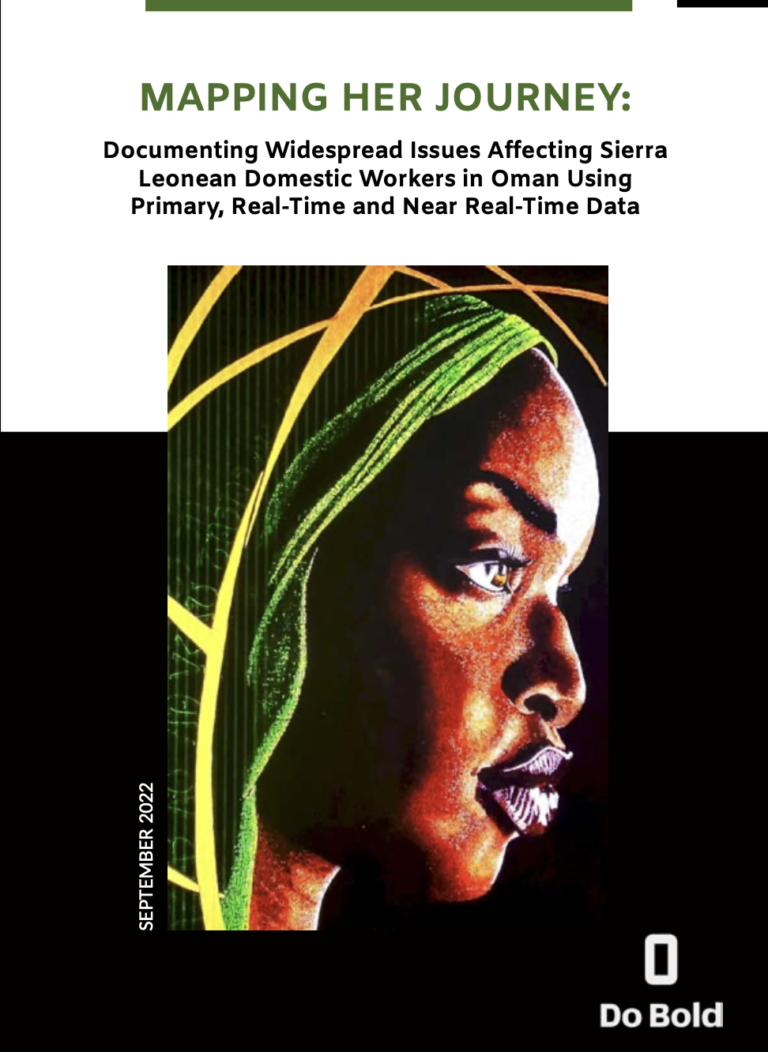
Domestic workers are one of the communities least protected by existing laws and one of the most vulnerable to exploitation in the world. We have documented an array of systemic and widespread abusive practices against Sierra Leonean women domestic workers in Oman that begin in the recruitment process and continue in their host country.

MAPPING HER JOURNEY: Documenting Widespread Issues Affecting Sierra Leonean Domestic Workers in Oman Using Primary, Real-Time and Near Real-Time Data - Do Bold, 2022 DOWNLOAD

post

page

attachment

revision

nav_menu_item

custom_css

customize_changeset

oembed_cache

user_request

wp_block

wp_template

wp_template_part

wp_global_styles

wp_navigation

wp_font_family

wp_font_face

acf-taxonomy

acf-post-type

acf-field-group

acf-field

ai1ec_event

exactmetrics_note

Regional study on defining recruitment fees and related costs: The Americas
Publications

This regional, comparative study aims to summarize the situation in the Americas, by identifying regional and national policies and legislation on defining recruitment fees and related costs and regulation of Public Employment Services (PES) and Pri...Read More

Gender
Publications

Edited by Sam Okyere and Prabha Kotiswaran. This is the eighth volume of the series Beyond Trafficking and Slavery Short Course. Women and girls, 'new abolitionists' say, are disproportionately affected by trafficking because of their preval...Read More

Establishing an Agile Response Process to Crisis and Conflict-related Modern Slavery and Human Trafficking Risks
Publications

In a constantly changing world, financial institutions must continually adapt to new risk factors. Regional or global crises like war or natural disasters, in particular, can trigger or fuel criminal activity and related risks,1 including MS/HT...Read More

TAGS:
Action against child labour in Lebanon: A mapping of policy and normative initiatives
Publications

The ILO commissioned this report from Ms. Hayat Osseiran, an independent researcher on child labour issues. The report should not be construed as representing the views of the ILO. The views expressed are those of the author and do not necessarily ...Read More