
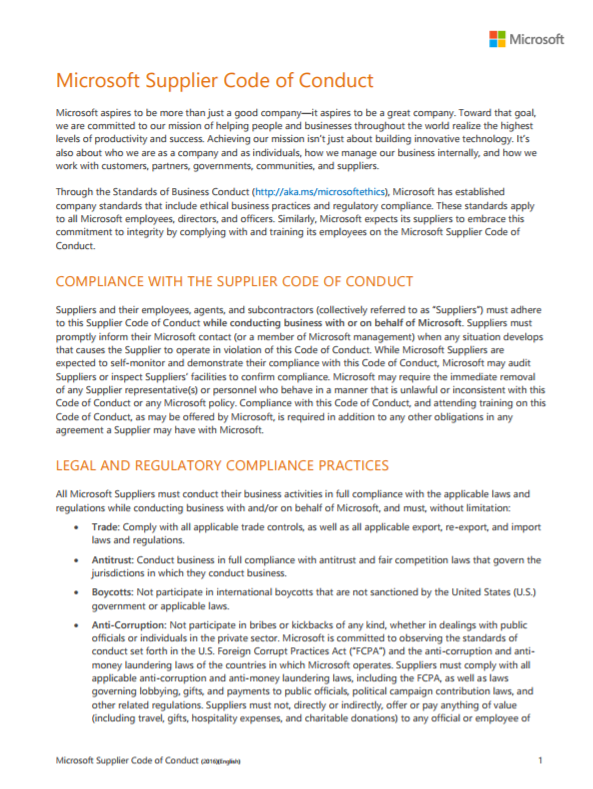
Through the Standards of Business Conduct, Microsoft has established company standards that include ethical business practices and regulatory compliance. These standards apply to all Microsoft employees, directors, and officers. Similarly, Microsoft expects its suppliers to embrace this commitment to integrity by complying with and training its employees on the Microsoft Supplier Code of Conduct.

Microsoft Supplier Code of Conduct - Microsoft, 2016 DOWNLOAD

post

page

attachment

revision

nav_menu_item

custom_css

customize_changeset

oembed_cache

user_request

wp_block

wp_template

wp_template_part

wp_global_styles

wp_navigation

wp_font_family

wp_font_face

acf-taxonomy

acf-post-type

acf-field-group

acf-field

ai1ec_event

exactmetrics_note

Responsible Business Conduct and the Tourism Industry in Vietnam: Guidance for Companies
GuidanceStandards & Codes of Conduct

As Vietnam’s tourism industry expands, the Australian Human Rights Commission and the Vietnam Chamber of Commerce and Industry have partnered to produce guidance for companies operating in the tourism industry in Vietnam. The guidance aims to stre...Read More

TAGS: Asia
Global Justice: Using Strategic Litigation to Combat Forced Labour
News & AnalysisStandards & Codes of ConductLegislation

Forced labor is a feature, not a bug, in today’s global economic system. Forced labor spans the globe. It involves multinational corporations. It is found in special economic zones—and war zones. And it is in everyone’s backyard. Globally, 27....Read More

Zain Supplier Code of Conduct
Standards & Codes of Conduct

The Code contains general requirements applicable to all suppliers to Zain Group, its operating companies, other subsidiaries and divisions (‘Zain’). Suppliers are defined as all those businesses that sell products and/or services to Zain, incl...Read More

Corporate Human Rights Benchmark 2022: Insights Report
News & AnalysisGuidanceStandards & Codes of Conduct

The Corporate Human Rights Benchmark (CHRB) assessed three sectors in 2022: food and agricultural products (57 companies), ICT manufacturing (43 companies) and automotive manufacturing (29 companies). The revised CHRB methodology devotes more at...Read More

TAGS: Global