
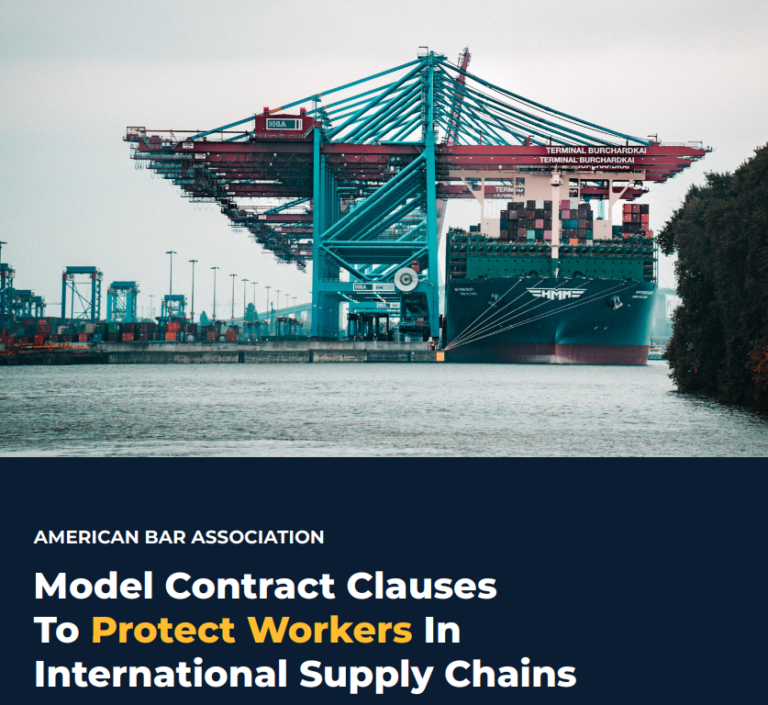
The American Bar Association (ABA) Business Law Section Working Group undertook an extensive project to help buyers and suppliers redesign their contracts to better protect human rights in supply chains, with a focus on a cooperative approach with shared responsibility.

This toolkit provides an overview of the ABA Model Contract Clauses (Versio n 2.0) (MCCs). We are not seeking to reproduce the clauses or guidance notes here, but simply to guide Mekong Club members to the relevant sections of the MCCs and related materials and highlight some of the key provisions.

Model Contract Clauses To Protect Workers In International Supply Chains - Mekong Club, 2023 DOWNLOAD

post

page

attachment

revision

nav_menu_item

custom_css

customize_changeset

oembed_cache

user_request

wp_block

wp_template

wp_template_part

wp_global_styles

wp_navigation

wp_font_family

wp_font_face

acf-taxonomy

acf-post-type

acf-field-group

acf-field

ai1ec_event

exactmetrics_note

Challenges of recognition of the status of human trafficking victim in the Republic of Serbia
Guidance

Trafficking in human beings is a global phenomenon encountered with by almost all countries in the world – either as countries of origin, transit, or final destination for the victims. Due to the complexity of the very phenomenon, numerous United ...Read More

Climate change, migration and vulnerability to trafficking
Guidance

This paper presents empirical evidence on the links between climate change, migration and trafficking. It then unpacks the underlying drivers that policymakers should target to deal with this nexus. The paper explores the extent and impact of climat...Read More

Recovery and Reintegration of Trafficking Victims: A Practitioner Guide
Guidance

This Practitioner Guide presents existing research and evidence on the recovery and reintegration of trafficking victims, including challenges faced and practices that can be mobilized to enhance reintegration outcomes. It is part of the NEXUS/RSO P...Read More

COVID-19: How to include marginalized and vulnerable people in risk communication and community engagement
COVID-19 resourcesGuidance

Women, the elderly, adolescents, youth, and children, persons with disabilities, indigenous populations, refugees, migrants, and minorities experience the highest degree of socio-economic marginalization. Marginalized people become even more vulnera...Read More

TAGS: Global