
Beauty and a Beast: Child labour in India for sparkling cars and cosmetics
PublicationsThis report focuses on child labour in Jharkhand/Bihar for mica mining and processing, and the role of Dutch companies and main manufacturers of pearlescent
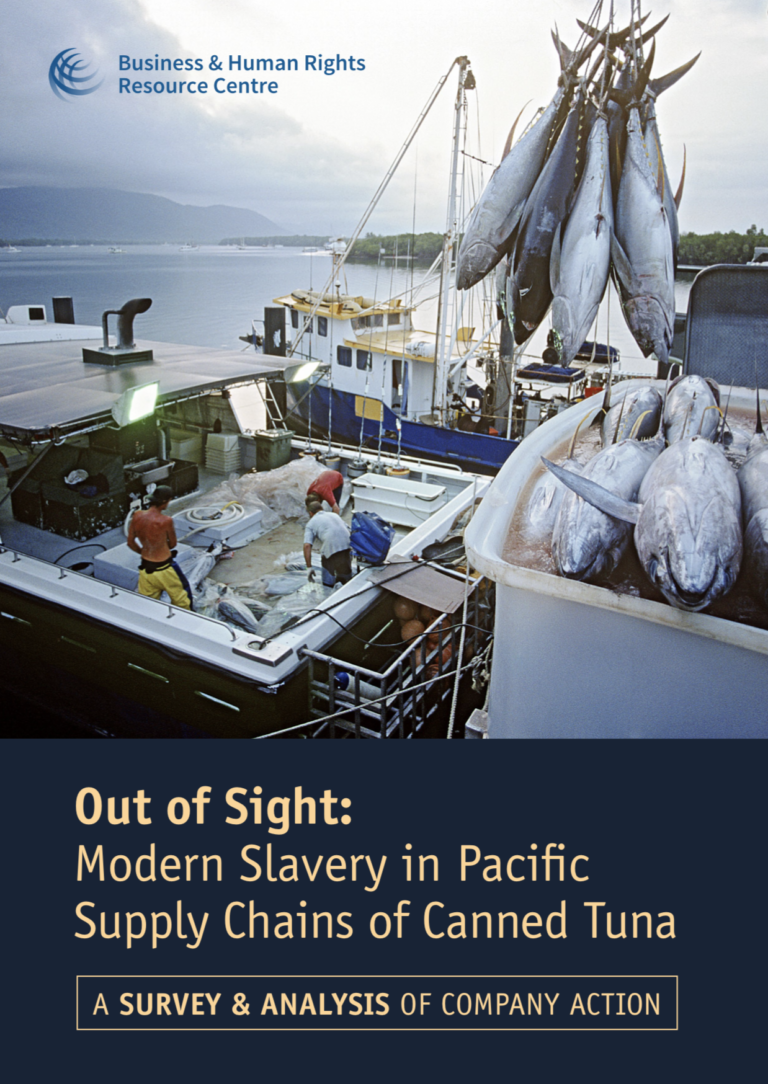
Between November 2018 and January 2019, Business & Human Rights Resource Centre invited 35 canned tuna companies and supermarkets – representing 80 of the world’s largest retail canned tuna brands – to answer a survey on their approach to human rights challenges, including modern slavery. They also reviewed publicly-available information on the websites of the 35 survey companies.
Their research reveals a pattern of policy over practice. While two thirds of surveyed companies have adopted corporate human rights policies, there is little or no action to implement them. Without urgent and decisive action, there is a danger these public policies become a fig-leaf for abuse: providing the majority of laggard companies with ‘plausible deniability’ while slavery continues unabated.
This report focuses on child labour in Jharkhand/Bihar for mica mining and processing, and the role of Dutch companies and main manufacturers of pearlescent
By Tom Sabo, Adam Pilz, SAS Institute Inc. Abstract The US Department of State (DOS) and other humanitarian agencies have a vested interest in assessing and preventing human trafficking in its many forms. A subdivision within the DOS releases pub...Read More
The COVID-19 pandemic has required States to implement exceptional measures to curb the spread of the virus and to protect public health. While border restrictions or closure may be justified, exceptions are needed to safeguard basic rights, includi...Read More
Over the past decade, scholars, activists, and policymakers have repeatedly called for an examination of the role of technology as a contributing force to human trafficking and exploitation. Attention has focused on a range of issues from adult serv...Read More