
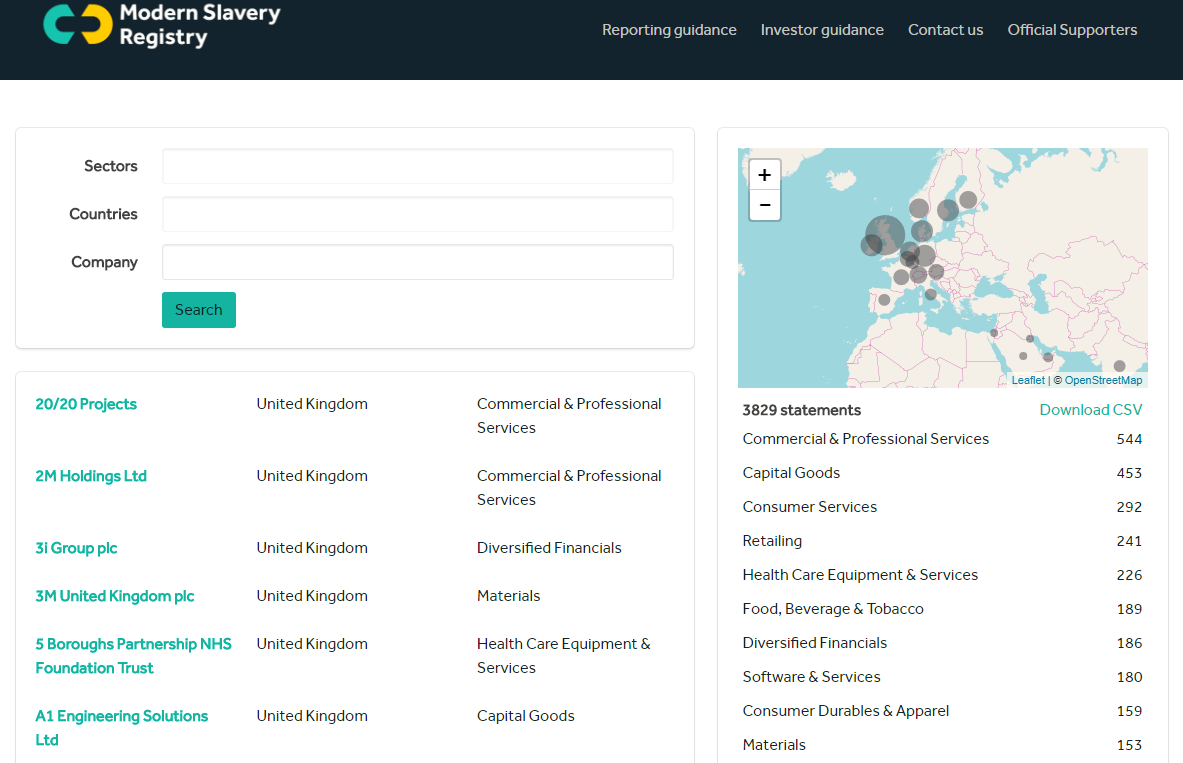
Modern Slavery Registry (http://www.modernslaveryregistry.org/) is a free, transparent and publicly accessible registry of company statements published pursuant to the UK Modern Slavery Act and the California Transparency in Supply Chains Act. The Registry, with its over 4,000 statements, is a valuable resource for companies to be able to see what their peers are reporting and learn better practices.


Click here to go to the Registry.

post

page

attachment

revision

nav_menu_item

custom_css

customize_changeset

oembed_cache

user_request

wp_block

wp_template

wp_template_part

wp_global_styles

wp_navigation

wp_font_family

wp_font_face

acf-taxonomy

acf-post-type

acf-field-group

acf-field

ai1ec_event

exactmetrics_note

Screening for Human Trafficking: Guidelines for Administering the Trafficking Victim Identification Tool
Online Tools

This manual is intended primarily for victim service agency staff and other social service providers, who will administer the Trafficking Victim Identification Tool (TVIT) to clients who are potential trafficking victims. Law enforcement, health car...Read More

Antislavery in Domestic Legislation Database
Online Tools

A continuing study by Katarina Schwarz and Jean Allain. To assess the extent to which slavery and related forms of human exploitation have been prohibited in domestic law, the Antislavery in Domestic Legislation Project compiles the constitution...Read More

TAGS: Global
Slavery Footprint
Online Tools

Slavery Footprint is a survey that asks and responds to the question, “How Many Slaves Work For You?” The survey allows users to input select data about their consumer spending habits, which then outputs a graphical “footprint” of the user...Read More

TAGS: Global
Repayment of Recruitment Fees to Workers: 4 Emerging Best Practices
Online ToolsGuidanceGood PracticesPublications

A growing number of global brands and retailers are adopting ethical recruitment policies stipulating, among other things, that all costs and fees related to labour recruitment are paid by the employer and not by the workers being recruited. Employe...Read More

TAGS: Asia