
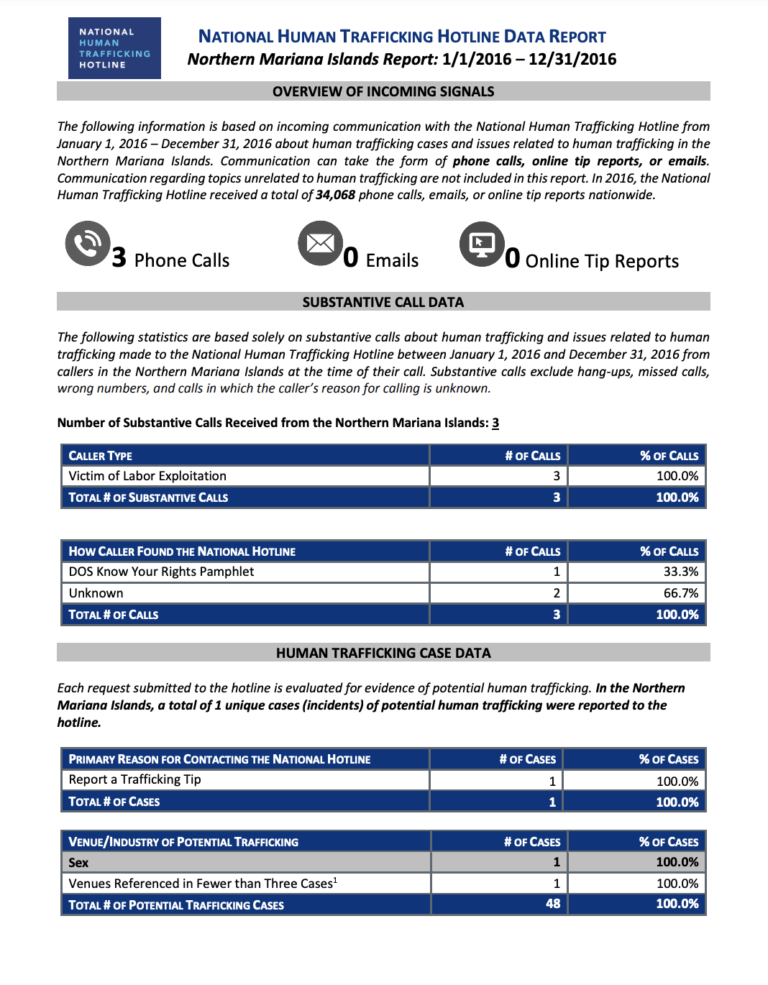
The following information is based on incoming communication with the National Human Trafficking Hotline from January 1, 2016 – December 31, 2016 about human trafficking cases and issues related to human trafficking in the Northern Mariana Islands. 

National Hotline 2016 - Northern Mariana Islands Report - National Human Trafficking Hotline, 2017 DOWNLOAD

post

page

attachment

revision

nav_menu_item

custom_css

customize_changeset

oembed_cache

user_request

wp_block

wp_template

wp_template_part

wp_global_styles

wp_navigation

wp_font_family

wp_font_face

acf-taxonomy

acf-post-type

acf-field-group

acf-field

ai1ec_event

exactmetrics_note

Risks and Considerations for Businesses with Supply Chain Exposure to Entities Engaged in Forced Labor and other Human Rights Abuses in Xinjiang
Publications

Businesses with potential exposure in their supply chain to the Xinjiang Uyghur Autonomous Region (Xinjiang) or to facilities outside Xinjiang that use labor or goods from Xinjiang should be aware of the reputational, economic, and legal risks of in...Read More

Money Laundering in the Commercial Sex Market in the United States
Publications

This paper describes money laundering techniques used by different criminal organizations operating in the U.S. sex market. Prior to this study, scholars have not investigated money laundering techniques used in the U.S. sex market in a comprehensiv...Read More

Underground Lives: Aspirational Britain: Survivors of Modern Slavery Want to Work Too
News & AnalysisPublications

Britain is in an employment crisis. Labour shortages are hitting record highs and firms are recruiting from abroad which is costly. At the same time there are currently more than 7,000 survivors of modern slavery who are being supported by the G...Read More

TAGS: Europe
Fishing For Data
Publications

Marine fisheries are critical resources for coastal developing countries. They are also difficult to manage sustainably. Almost a third of global fish stocks are degraded from overfishing, and a further 60% are ‘fully exploited’ (FAO, 2016). Ille...Read More