
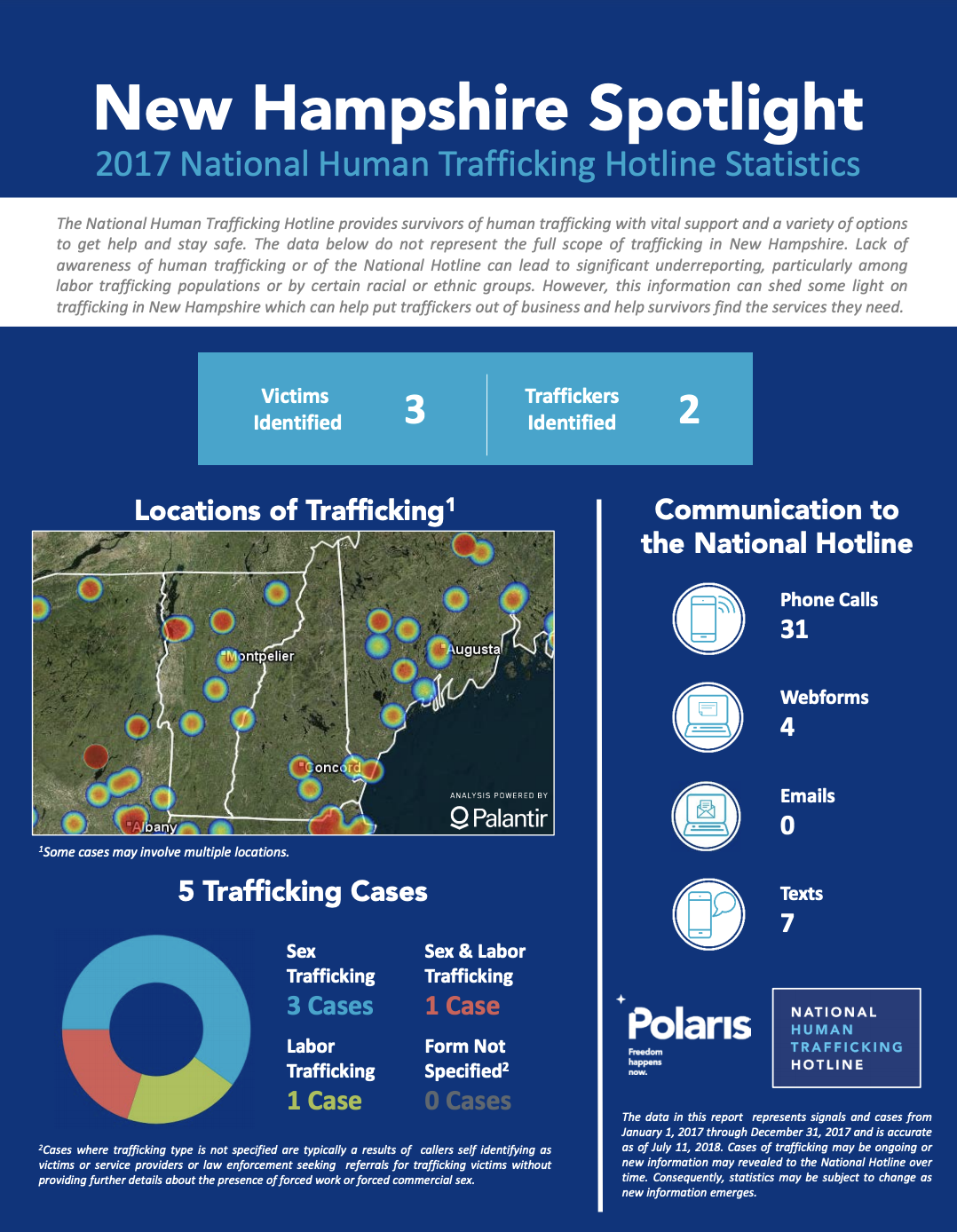
The data in this report represents signals and cases from January 1, 2017 through December 31, 2017 and is accurate as of July 11, 2018. Cases of trafficking may be ongoing or new information may be revealed to the National Hotline over time. Consequently, statistics may be subject to change as new information emerges.

You can download the report infographic below.

National Hotline 2017 New Hampshire State Report - National Human Trafficking Hotline, 2018 DOWNLOAD

post

page

attachment

revision

nav_menu_item

custom_css

customize_changeset

oembed_cache

user_request

wp_block

wp_template

wp_template_part

wp_global_styles

wp_navigation

wp_font_family

wp_font_face

acf-taxonomy

acf-post-type

acf-field-group

acf-field

ai1ec_event

exactmetrics_note

How Technology Fuels Trafficking and Exploitation in Asia and the Pacific
Publications

The total number of modern slavery victims in the world today is estimated to be 40.3 million. Out of this shocking figure, more than half of the victims - at least 24.9 million - are in Asia and the Pacific. This region has the highest number of vi...Read More

Preventing modern slavery & human trafficking: An agenda for action across the financial services sector
GuidancePublications

There are over 40 million people in modern slavery worldwide. Modern slavery exists in every industry, in every country in the world. The financial services industry has a major role to play in combating this violent and abusive business. And yet th...Read More

Governing Global Supply Chain Sustainability through the Ethical Audit Regime
Publications

Over the past two decades multinational corporations have been expanding ‘ethical’ audit programs with the stated aim of reducing the risk of sourcing from suppliers with poor practices. A wave of government regulation—such as the California T...Read More

Combating Forced and Child Labor of Refugees in Global Supply Chains: The Role of Responsible Sourcing
GuidancePublications

With the global refugee crisis showing no signs of abating, multinational companies need to consider how their supply chain interacts with refugees, who are often more vulnerable to forced labor when they seek out work in a new country. Combating F...Read More