
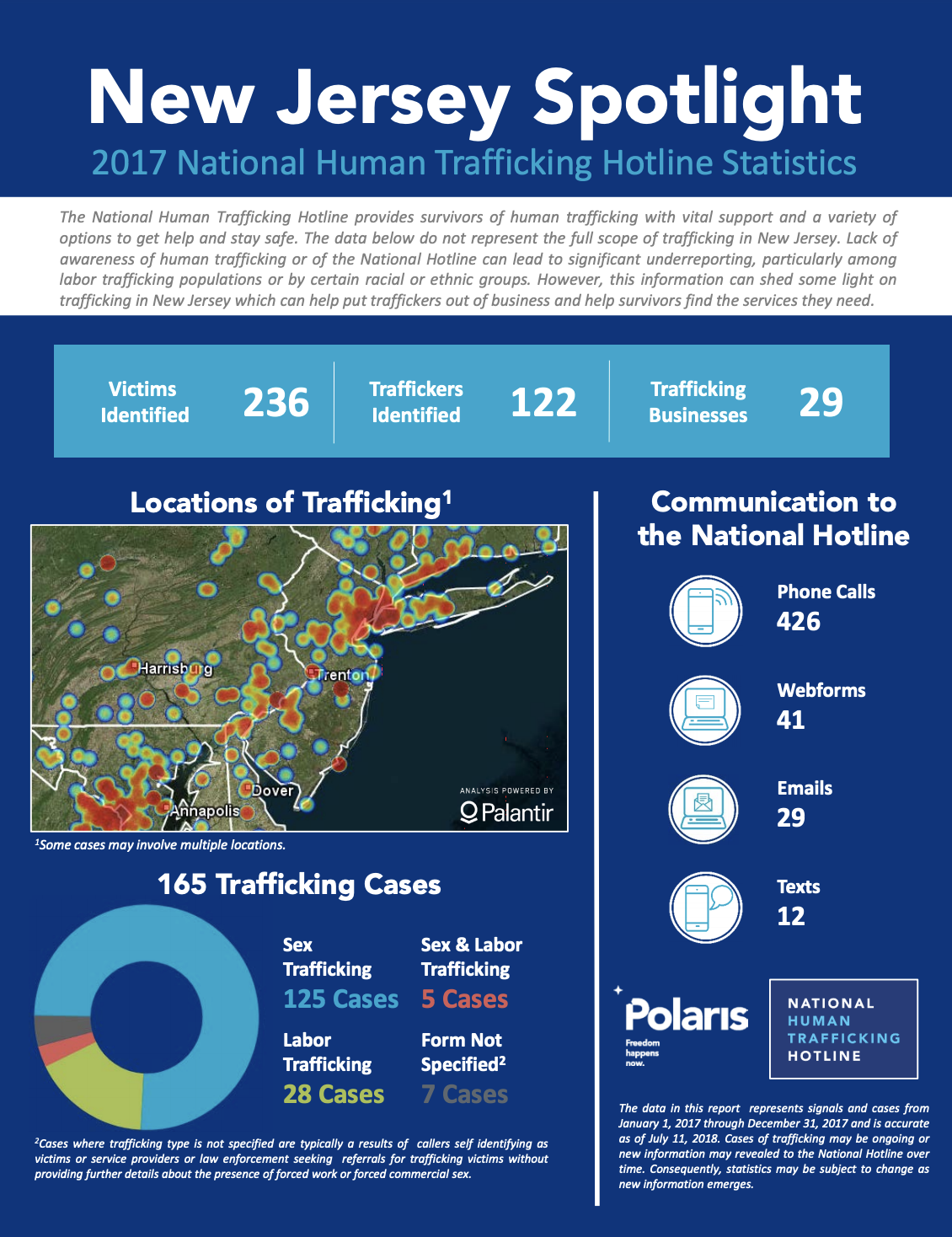
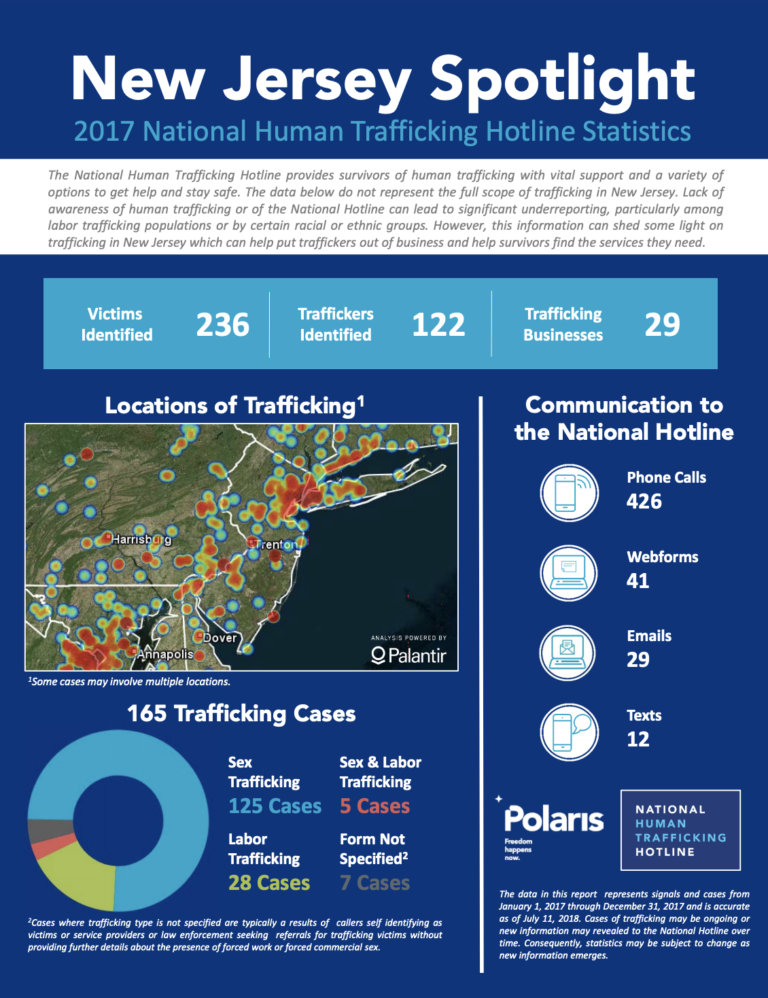
The data in this report represents signals and cases from January 1, 2017 through December 31, 2017 and is accurate as of July 11, 2018. Cases of trafficking may be ongoing or new information may be revealed to the National Hotline over time. Consequently, statistics may be subject to change as new information emerges.

You can download the report infographic below.

National Hotline 2017 New Jersey State Report - National Human Trafficking Hotline, 2018 DOWNLOAD

post

page

attachment

revision

nav_menu_item

custom_css

customize_changeset

oembed_cache

user_request

wp_block

wp_template

wp_template_part

wp_global_styles

wp_navigation

wp_font_family

wp_font_face

acf-taxonomy

acf-post-type

acf-field-group

acf-field

ai1ec_event

exactmetrics_note

Addressing the Gender Dimensions of Trafficking in Persons in the Context of Climate Change, Displacement and Disaster Risk Reduction – Report of the Special Rapporteur on trafficking in persons, especially women and children, Siobhán Mullally
Publications

The heightened risks of trafficking in the context of climate change are rooted in existing and persistent inequalities, in poverty, in racism, and in discrimination. These heightened risks and vulnerability to exploitation are not inevitable or fix...Read More

TAGS: Global
Fishing For Data
Publications

Marine fisheries are critical resources for coastal developing countries. They are also difficult to manage sustainably. Almost a third of global fish stocks are degraded from overfishing, and a further 60% are ‘fully exploited’ (FAO, 2016). Ille...Read More

Pathways for children to exit commercial sexual exploitation in Kathmandu
Publications

Commercial sexual exploitation of children (CSEC) affects an estimated 1.8 million children globally. In Nepal, the adult entertainment sector (AES) is recognised as a high-risk environment for children where sexual exploitation is known to occur. Th...Read More

What Works: Lessons in the Use of Cash Transfers
Publications

Cash transfers are used as a tool to empower and protect vulnerable individuals, households, and other groups from shocks and to mitigate vulnerabilities, such as low and variable income. These transfers can also be used to encourage positive change...Read More