
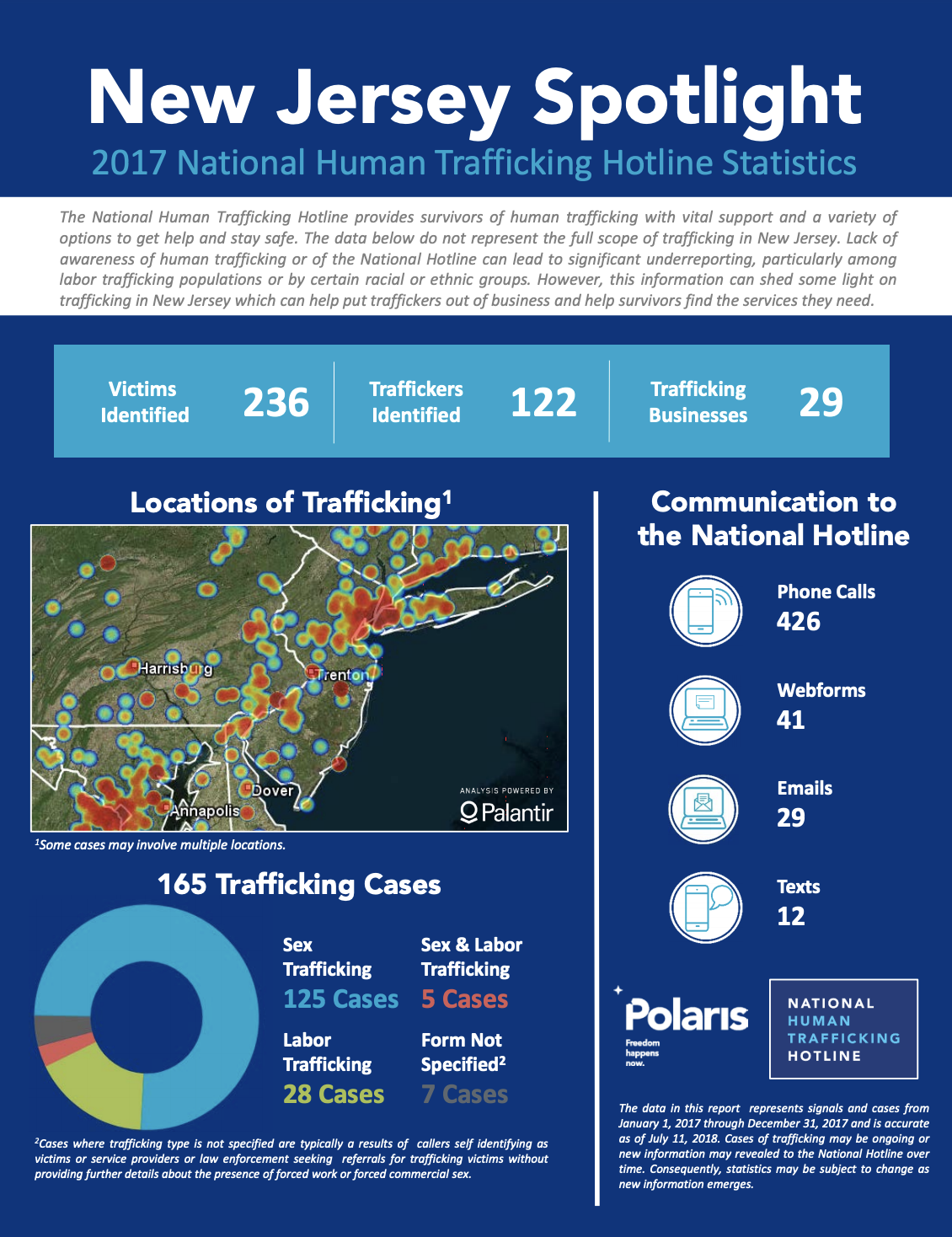
The data in this report represents signals and cases from January 1, 2017 through December 31, 2017 and is accurate as of July 11, 2018. Cases of trafficking may be ongoing or new information may be revealed to the National Hotline over time. Consequently, statistics may be subject to change as new information emerges.

You can download the report infographic below.

National Hotline 2017 New Jersey State Report - National Human Trafficking Hotline, 2018 DOWNLOAD

post

page

attachment

revision

nav_menu_item

custom_css

customize_changeset

oembed_cache

user_request

wp_block

wp_template

wp_template_part

wp_global_styles

wp_navigation

wp_font_family

wp_font_face

acf-taxonomy

acf-post-type

acf-field-group

acf-field

ai1ec_event

exactmetrics_note

Supply Chain Risk Report: Child and forced labour in Canadian consumer products
Publications

The report looks at Canada’s connection to the issues of human trafficking and forced and child labour, by cross-referencing recent data on Canadian imports with the U.S. Department of Labour’s List of Goods Produced by Child Labour or Forced Lab...Read More

National Hotline 2019 Nebraska State Report
Graphics & InfographicsPublications

The data in this report represents signals and cases from January 1, 2019 through December 31, 2019 and is accurate as of July 30, 2020. Cases of trafficking may be ongoing or new information may revealed to the National Hotline over time. Consequen...Read More

Slavery Free Recruitment Systems: A Landscape Analysis of Fee-Free Recruitment Initiatives
Publications

This brief has been prepared by Phil Marshall, Technical Consultant to the Issara Institute. This paper summarizes the current discussion around fee-free recruitment, including: (1) definitions of fee-free recruitment; (2) linkages between migra...Read More

Impact of the CARE Tipping Point Program in Nepal on adolescent girls’ agency and risk of child, early, or forced marriage: Results from a cluster-randomized controlled trial
Publications

ackground: Girl child, early, and forced marriage (CEFM) persists in South Asia, with long-term effects on well- being. CARE’s Tipping Point Initiative (TPI) sought to address the gender norms and inequalities underlying CEFM by engaging part...Read More

TAGS: