
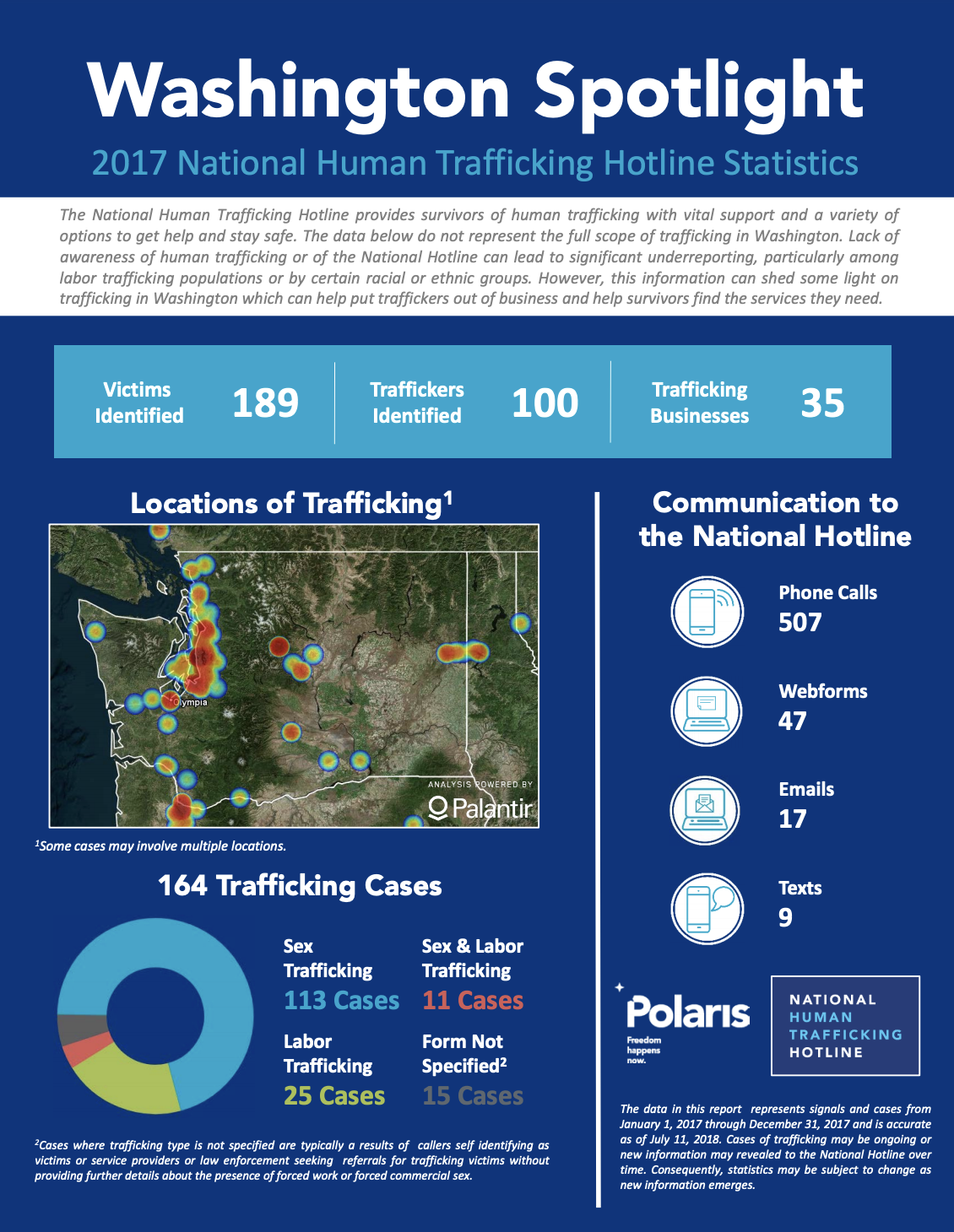
The data in this report represents signals and cases from January 1, 2017 through December 31, 2017 and is accurate as of July 11, 2018. Cases of trafficking may be ongoing or new information may be revealed to the National Hotline over time. Consequently, statistics may be subject to change as new information emerges.

You can download the report infographic below.

National Hotline 2017 Washington State Report - National Human Trafficking Hotline, 2018 DOWNLOAD

post

page

attachment

revision

nav_menu_item

custom_css

customize_changeset

oembed_cache

user_request

wp_block

wp_template

wp_template_part

wp_global_styles

wp_navigation

wp_font_family

wp_font_face

acf-taxonomy

acf-post-type

acf-field-group

acf-field

ai1ec_event

exactmetrics_note

Twenty Years After the Passage of the Palermo Protocol: Identifying Common Flaws in Defining Trafficking through the First Global Study of Domestic Anti-Trafficking Laws
Publications

On November 15, 2000, the United Nations adopted the Protocol to Prevent, Suppress and Punish Trafficking in Persons, Especially Women and Children (Palermo Protocol). Twenty years later, with 178 state parties, the Palermo Protocol has reached almo...Read More

TAGS: Global
Strengthening Protection Against Trafficking in Persons in Federal and Corporate Supply Chains
Publications

Verité has collected comprehensive data about global industries with a significant history or current evidence of human trafficking or trafficking-related activity, and has analysed the over-lap between global supply chains deemed to be at risk for ...Read More

Developing Freedom: The Sustainable Development Case for Ending Modern Slavery, Forced Labour and Human Trafficking
Publications

40.3 million people – around 1 in every 185 people alive – experienced modern slavery or forced labour in 2016. States have committed to take immediate and effective measures to end modern slavery, forced labour and human trafficking by 2030, an...Read More

Deadly Secrets: How Apparel Brands Cover up Safety Hazards
Publications

For many years the dirty secret of the steadily growing Bangladeshi garment industry has been its underpaid workers, treated as disposable objects. The lowest paid garment workers anywhere in the world, hundreds of them have died in preventable fact...Read More