
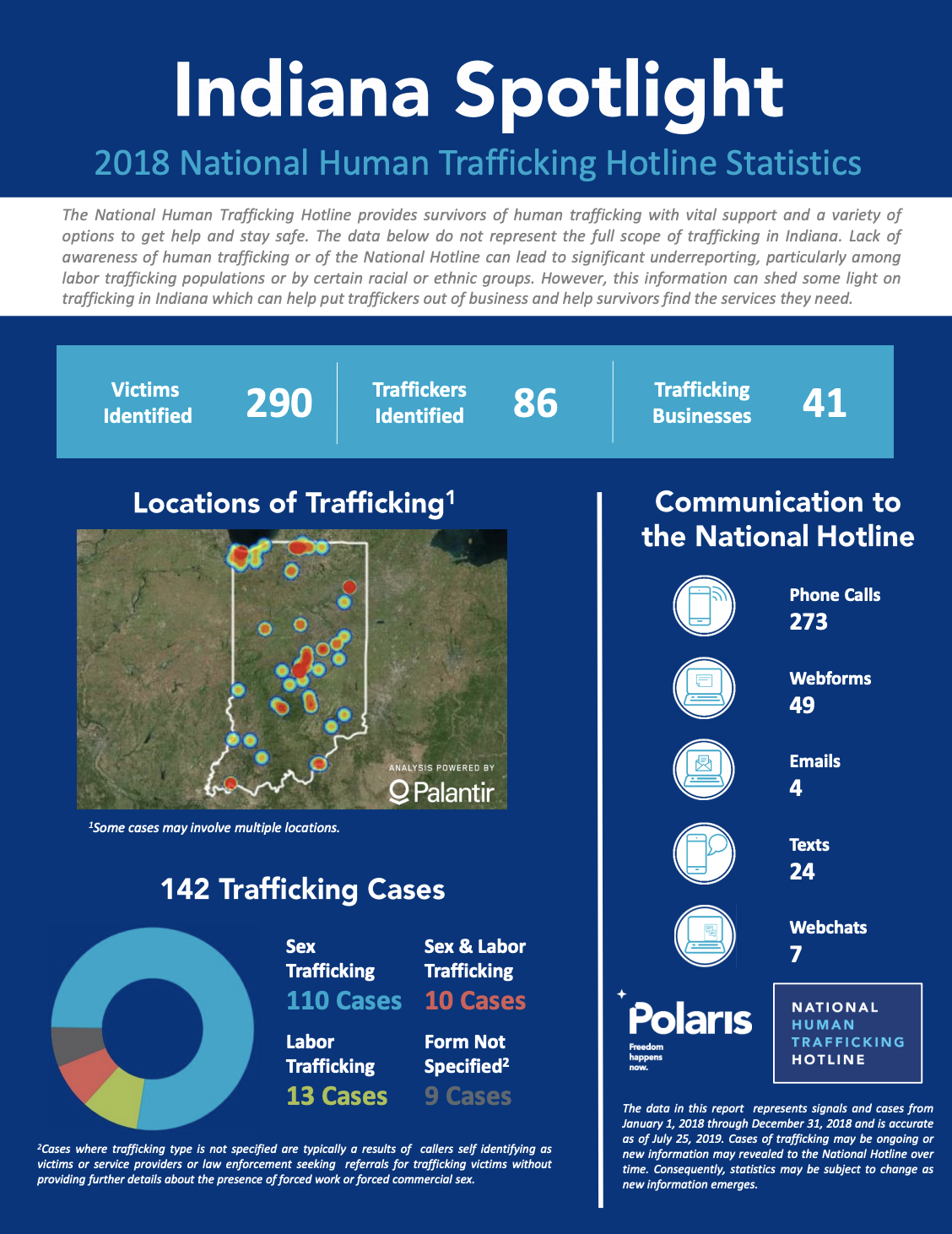
The data in this report represents signals and cases from January 1, 2018 through December 31, 2018 and is accurate as of July 25, 2019. Cases of trafficking may be ongoing or new information may revealed to the National Hotline over time. Consequently, statistics may be subject to change as new information emerges.

You can download the report infographic below.

National Hotline 2018 Indiana State Report - National Human Trafficking Hotline, 2019 DOWNLOAD

post

page

attachment

revision

nav_menu_item

custom_css

customize_changeset

oembed_cache

user_request

wp_block

wp_template

wp_template_part

wp_global_styles

wp_navigation

wp_font_family

wp_font_face

acf-taxonomy

acf-post-type

acf-field-group

acf-field

ai1ec_event

exactmetrics_note

Supermarket Responsibilities for Supply Chain Workers’ Rights – Continuing Challenges in Seafood Supply Chains and the Case for Stronger Supermarket Action
Publications

International food supply chains provide employment for tens of millions of women and men around the world, demonstrating the potential for private sector actors to fight poverty and inequality. Yet far too many work in appalling conditions. The o...Read More

Minors in Kathmandu’s adult entertainment sector: What’s driving demand?
Publications

Kathmandu’s adult entertainment sector (AES) is made up of a complex web of venues that includes massage parlours, dance bars, cabin restaurants and guest houses. These workplaces employ young women and girls as waitresses and dancers who entertain...Read More

The Impact of COVID-19 on Modern Slavery and Human Trafficking
COVID-19 resourcesPublications

This publication provides an overview of the epidemic of modern slavery and human trafficking, surveys some of ways that these challenges have been negatively transformed by COVID-19, and explores how approaches rooted in principles of computational...Read More

The Torture in My Mind: The Right to Mental Health for Rohingya Survivors in Myanmar and Bangladesh
Publications

United Nations agencies estimate that 12 months after an emergency, approximately 15 to 20 percent of adults will experience some type of moderate or mild mental health disorder. However, data published today reveals that 88.7 percent of Rohingya re...Read More

TAGS: Asia