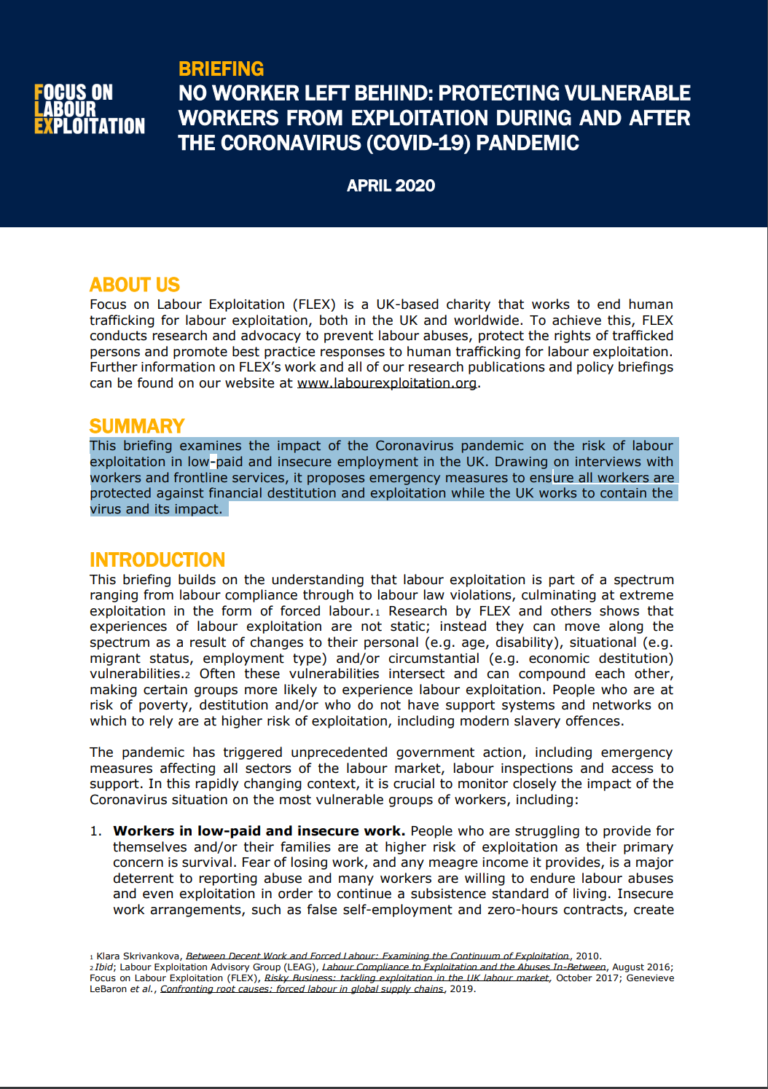
This briefing builds on the understanding that labour exploitation is part of a spectrum ranging from labour compliance through to labour law violations, culminating at extreme exploitation in the form of forced labour. Research by FLEX and others shows that experiences of labour exploitation are not static; instead they can move along the spectrum as a result of changes to their personal (e.g. age, disability), situational (e.g. migrant status, employment type) and/or circumstantial (e.g. economic destitution) vulnerabilities.2 Often these vulnerabilities intersect and can compound each other, making certain groups more likely to experience labour exploitation. People who are at risk of poverty, destitution and/or who do not have support systems and networks on which to rely are at higher risk of exploitation, including modern slavery offences.

No Worker Left Behind: Protecting Vulnerable Workers from Exploitation During and After the COVID-19 Pandemic - Focus on Labour Exploitation, 2020 DOWNLOAD

post

page

attachment

revision

nav_menu_item

custom_css

customize_changeset

oembed_cache

user_request

wp_block

wp_template

wp_template_part

wp_global_styles

wp_navigation

wp_font_family

wp_font_face

acf-taxonomy

acf-post-type

acf-field-group

acf-field

ai1ec_event

exactmetrics_note

Strengthening Protection Against Trafficking in Persons in Federal and Corporate Supply Chains
Publications

Verité has collected comprehensive data about global industries with a significant history or current evidence of human trafficking or trafficking-related activity, and has analysed the over-lap between global supply chains deemed to be at risk for ...Read More

Freedom First Celebrating 20 Years of Progress to Combat Human Trafficking
Publications

This retrospective report provides a historical perspective on the context in which the TVPA (the Trafficking Victims Protection Act of 2000) was crafted, celebrates the major accomplishments of the United States government, and provides a view of t...Read More

Decision No. 1107 Addendum to the OSCE Action Plan to Combat Trafficking in Human Beings: One Decade Later
Publications

The Addendum complements the OSCE Action Plan to Combat Trafficking in Human Beings adopted in 2003 and supplemented in 2005, and provides the OSCE participating States with an updated toolkit to combat all forms of trafficking in human beings (THB)....Read More

Responsible Management of Workforce Reduction in Thailand in the Covid-19 Environment
COVID-19 resources

This brief aims to advise Thai suppliers and global brands and retailers, and inform a broader audience, regarding the impact of workforce reductions on foreign migrant workers in Thailand, especially MoU workers hired through the formal recruitment...Read More

TAGS: