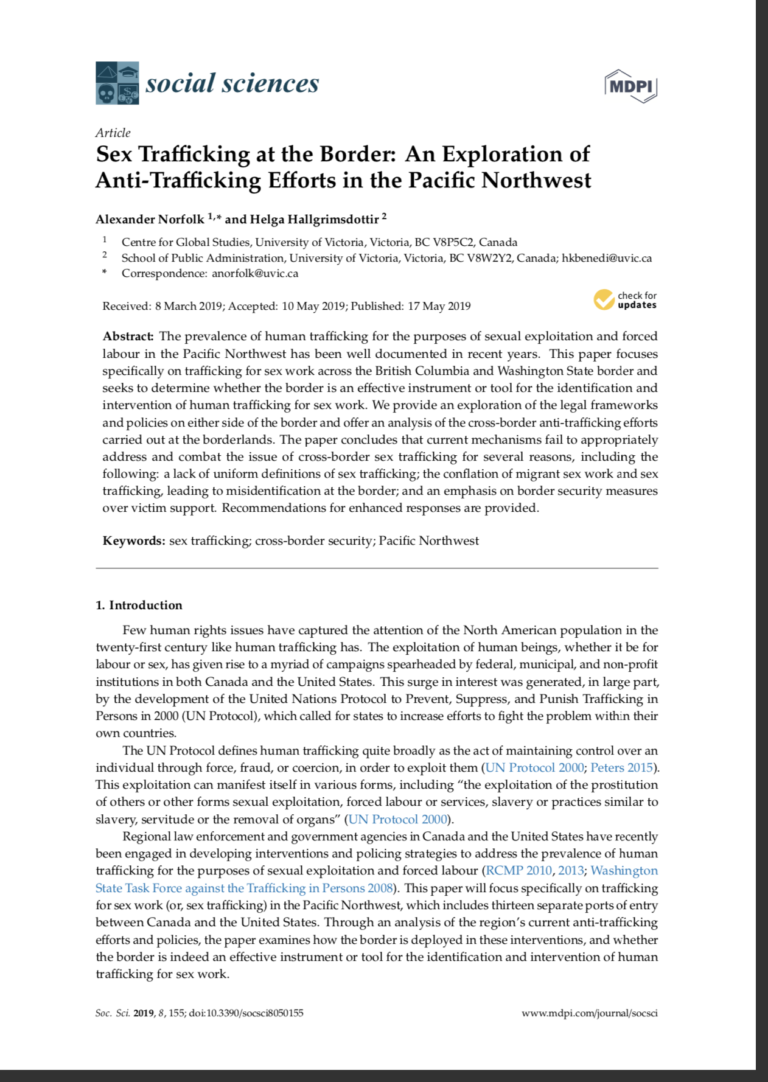
The prevalence of human trafficking for the purposes of sexual exploitation and forced labour in the Pacific Northwest has been well documented in recent years. This paper focuses specifically on trafficking for sex work across the British Columbia and Washington State border and seeks to determine whether the border is an effective instrument or tool for the identification and intervention of human trafficking for sex work. We provide an exploration of the legal frameworks and policies on either side of the border and offer an analysis of the cross-border anti-trafficking efforts carried out at the borderlands. The paper concludes that current mechanisms fail to appropriately address and combat the issue of cross-border sex trafficking for several reasons, including the following: a lack of uniform definitions of sex trafficking; the conflation of migrant sex work and sex trafficking, leading to misidentification at the border; and an emphasis on border security measures over victim support. Recommendations for enhanced responses are provided.

Sex Trafficking at the Border: An Exploration of Anti-Trafficking Efforts in the Pacific Northwest DOWNLOAD

post

page

attachment

revision

nav_menu_item

custom_css

customize_changeset

oembed_cache

user_request

wp_block

wp_template

wp_template_part

wp_global_styles

wp_navigation

wp_font_family

wp_font_face

acf-taxonomy

acf-post-type

acf-field-group

acf-field

ai1ec_event

exactmetrics_note

The Reality of Corporate Social Responsibility: Case Studies on the Impact of CSR on Workers in China, South Korea, India and Indonesia
Publications

Asia Monitor Resource Centre (AMRC) has been working to understand and deal with the unprecedented impacts of Corporate Social Responsibility (CSR) on the working population. In the past few years, AMRC developed a core position paper on the CSR tha...Read More

Fake my Catch: The Unreliable Untraceability in Our Tuna Cans
News & AnalysisPublications

US seafood company Bumble Bee, one of the leading companies in the canned tuna market with nearly 90% consumer awareness levels, and its Taiwanese parent company Fong Chun Formosa Fishery Company (hereinafter referred to as FCF), one of the top thre...Read More

Human Trafficking and Risky Migration Routes: DATA insights from SOMALI Civil Society Organisations
Publications

The anti-trafficking Somali Civil Society Organisations (CSO) Coalition, Freedom Collaborative and GIZ, working under the Better Migration Management (BMM II) programme, are pleased to share a new report on Somali human trafficking and risky migrati...Read More

Using SAS® Text Analytics to Assess International Human Trafficking Patterns
Good PracticesPublications

By Tom Sabo, Adam Pilz, SAS Institute Inc. Abstract  The US Department of State (DOS) and other humanitarian agencies have a vested interest in assessing and preventing human trafficking in its many forms. A subdivision within the DOS releases pub...Read More