
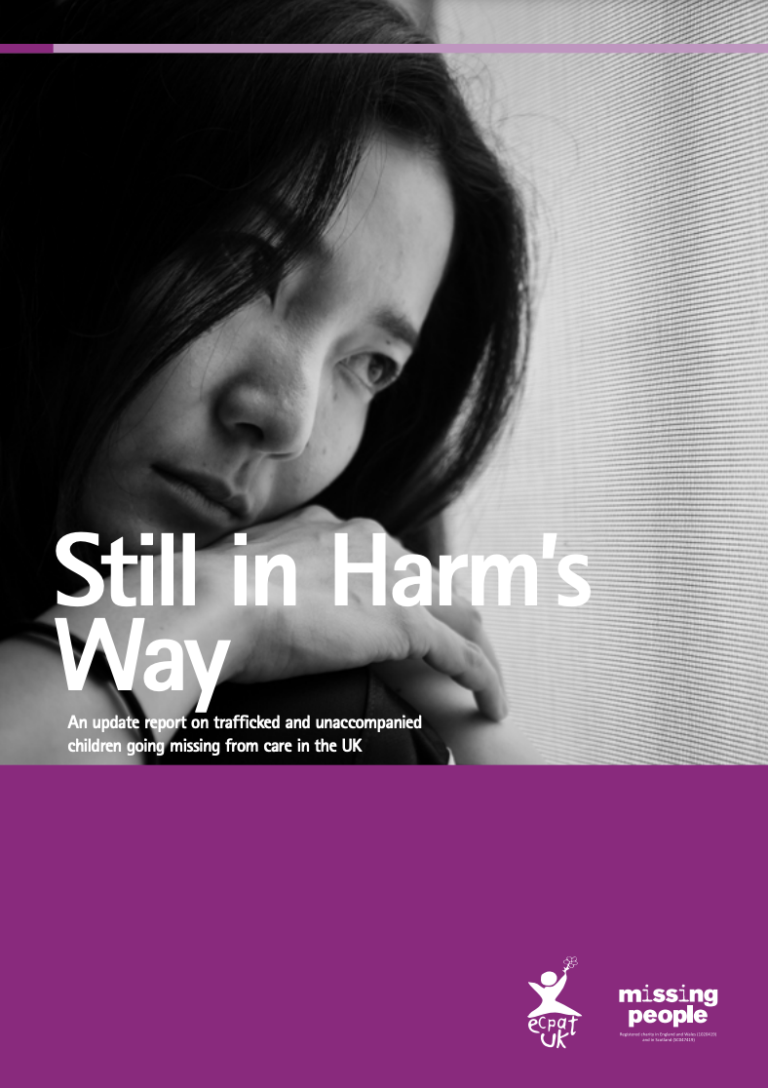
Following the ground-breaking 2016 report Heading Back to Harm, leading charities ECPAT UK and Missing People have revisited the issue using 2017 data to assess what has changed. Still in Harm’s Way: An update report on trafficked and unaccompanied children going missing from care in the UK shows that trafficked and unaccompanied children are still going missing from care at an alarmingly high rate.

Still in Harm's Way - ECPAT UK, 2019 DOWNLOAD

post

page

attachment

revision

nav_menu_item

custom_css

customize_changeset

oembed_cache

user_request

wp_block

wp_template

wp_template_part

wp_global_styles

wp_navigation

wp_font_family

wp_font_face

acf-taxonomy

acf-post-type

acf-field-group

acf-field

ai1ec_event

exactmetrics_note

In Harm’s Way: How Systems Fail Human Trafficking Survivors
Publications

The National Survivor Survey is the largest and most significant effort to date to learn directly from survivors of sex and labor trafficking. This report uses the findings from this study to paint a detailed picture of the arc of trafficking – fr...Read More

Eliminating Child Labour in Malawi
Publications

British American Tobacco co‐founded the Eliminating Child Labour in Tobacco Growing Foundation (ECLT) in October 2000 and launched its pilot project in Malawi. This paper investigates the tobacco industry in Malawi. ...Read More

Pathways for children to exit commercial sexual exploitation in Kathmandu
Publications

Commercial sexual exploitation of children (CSEC) affects an estimated 1.8 million children globally. In Nepal, the adult entertainment sector (AES) is recognised as a high-risk environment for children where sexual exploitation is known to occur. Th...Read More

Acknowledged but Forgotten: The Gender Dimensions of Sexual Violence Against Migrant Domestic Workers in Post-Crisis Lebanon
News & AnalysisPublications

In December 2020, the Lebanese Parliament passed the landmark Law 205 against sexual harassment that could see perpetrators spend up to four years in prison and pay fines up to fifty times the minimum wage. The law additionally affords protection to...Read More