
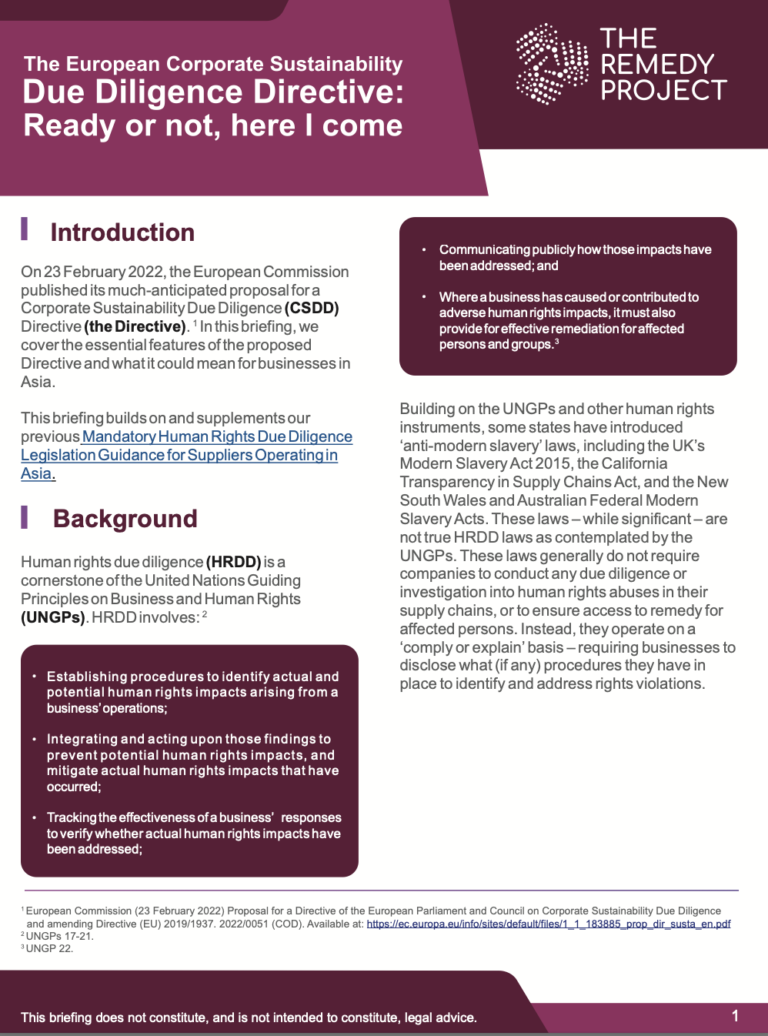
On 23 February 2022, the European Commission published its much-anticipated proposal for a Corporate Sustainability Due Diligence (CSDD) Directive (the Directive). In this briefing, we cover the essential features of the proposed Directive and what it could mean for businesses in Asia. This briefing builds on and supplements our previous Mandatory Human Rights Due Diligence Legislation Guidance for Suppliers Operating in Asia.

The European Corporate Sustainability Due Diligence Directive: Ready or Not, Here I Come - The Remedy Project, February 2022 DOWNLOAD

post

page

attachment

revision

nav_menu_item

custom_css

customize_changeset

oembed_cache

user_request

wp_block

wp_template

wp_template_part

wp_global_styles

wp_navigation

wp_font_family

wp_font_face

acf-taxonomy

acf-post-type

acf-field-group

acf-field

ai1ec_event

exactmetrics_note

Free and Fair Labor in Palm Oil Production: Principles and Implementation Guidance
Guidance

The Free and Fair Labor Principles (“Principles”) and corresponding Implementation Guidance (“Guidance”) is intended to support and advance the ongoing dialogue on responsible palm oil by providing a common point of reference on what consti...Read More

Doing Business with Respect for Human Rights: A Guidance Tool for Companies
Guidance

This guidance is for company staff who want to understand what “doing business with respect for human rights” means. It is for anyone who faces – or could face – scenarios in which their function, department or company could be connected to ...Read More

TAGS:
2018 Statistics from the National Human Trafficking
GuidanceGood Practices

The U.S. National Human Trafficking Hotline provides survivors of human trafficking with vital support and options to get help and stay safe. These options may include connecting callers with emergency shelter, transportation, trauma counselors, loc...Read More

Experts by Experience: Conducting Feminist Participatory Action Research with Workers in High-Risk Sectors
Guidance

The purpose of this guide is twofold. The first is to document lessons learned from using Feminist Participatory Action Research (FPAR) to study the experiences and drivers of labour exploitation – and advocate for change – with workers from thr...Read More