
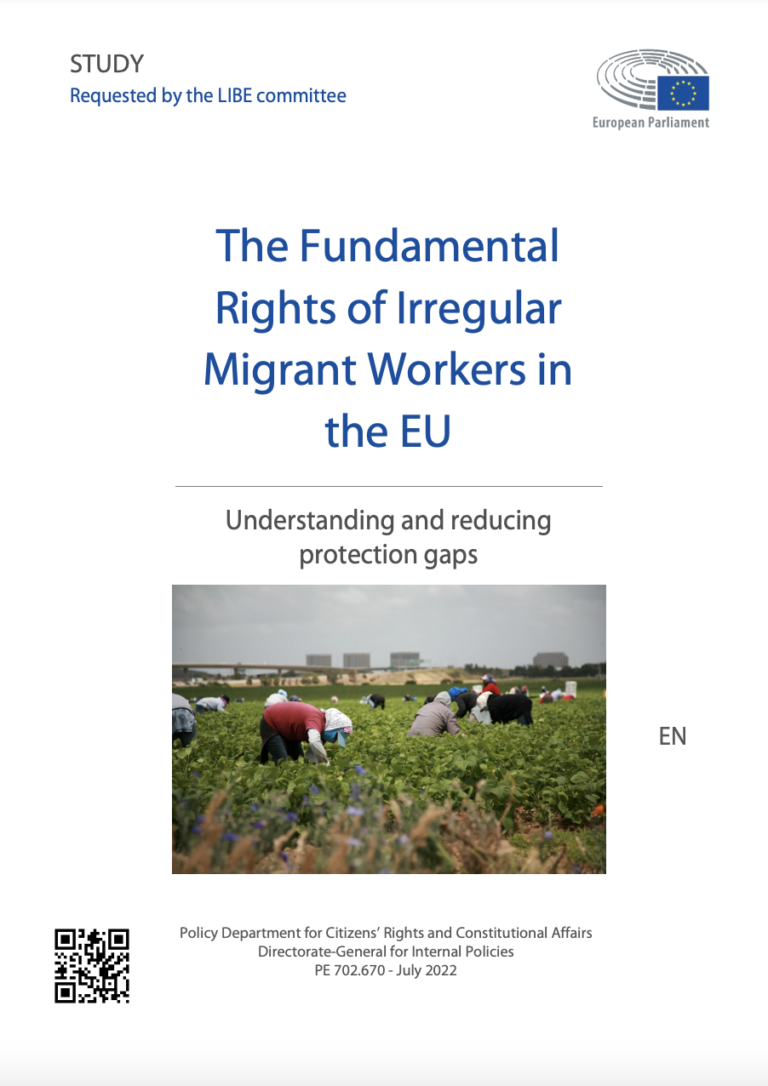
This study, commissioned by the European Parliament’s Policy Department for Citizens’ Rights and Constitutional Affairs at the request of the LIBE Committee, aims to inform policy debates about how to protect more effectively the fundamental rights of irregular migrant workers in the EU. It analyses the nature and causes of the gaps between the fundamental rights protections enshrined in EU legal standards and the rights realised by irregular migrants working in EU Member States in practice, and it discusses strategies for how these ‘protection gaps’ can be reduced.

The Fundamental Rights of Irregular Migrant Workers in the EU: Understanding and Reducing Protection Gaps - Policy Department for Citizens’ Rights and Constitutional Affairs, European Parliament, 2022 DOWNLOAD

post

page

attachment

revision

nav_menu_item

custom_css

customize_changeset

oembed_cache

user_request

wp_block

wp_template

wp_template_part

wp_global_styles

wp_navigation

wp_font_family

wp_font_face

acf-taxonomy

acf-post-type

acf-field-group

acf-field

ai1ec_event

exactmetrics_note

Responsible Business Conduct and the Tourism Industry in Vietnam: Guidance for Companies
GuidanceStandards & Codes of Conduct

As Vietnam’s tourism industry expands, the Australian Human Rights Commission and the Vietnam Chamber of Commerce and Industry have partnered to produce guidance for companies operating in the tourism industry in Vietnam. The guidance aims to stre...Read More

TAGS: Asia
Using Worker Voice Tools to Assess Relationships Between Workers and their Managers
Guidance

This note focuses on one dimension of how technology-enabled worker voice tools can be used: to gather qualitative data about the nature of relationships between managers and workers or communities at factories, farms, mines, and plantations. This i...Read More

National Referral Mechanisms – Joining Efforts to Protect the Rights of Trafficked Persons: A Practical Handbook
GuidanceGood Practices

National referral mechanisms (NRMs) are the institutional mechanisms that help states identify human trafficking victims and ensure their protection. This handbook provides a guidance model which all OSCE participating States can adapt and apply wit...Read More

An Ethical Framework for Cross-Border Labor Recruitment: An Industry/Stakeholder Collaboration to Reduce the Risks of Forced Labor and Human Trafficking – Verite and Manpower Group, 2012
GuidanceStandards & Codes of ConductPublications

The Ethical Framework for Cross Border Labor Recruitment offers a set of specific operational practices (“Standards of Ethical Practice”) for recruitment firms that operate across borders. These practices are reinforced by a Verification and Cer...Read More