
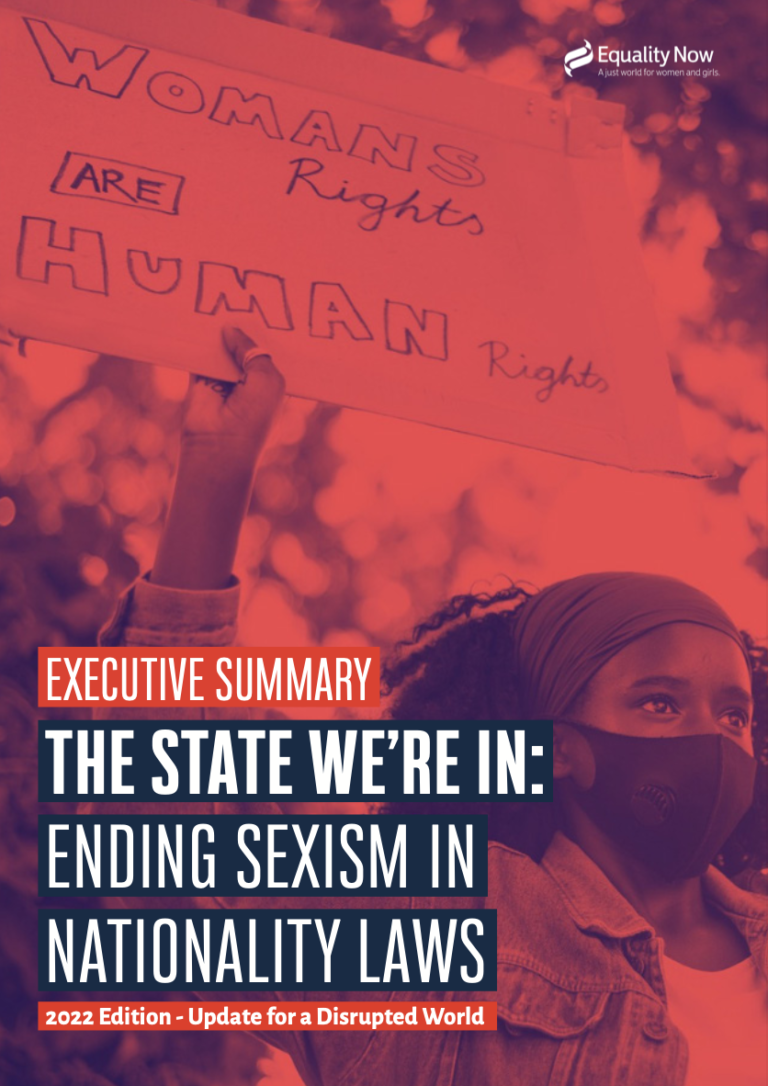
This updated report from Equality Now, reflecting women’s intersecting realities and the devastating impact of the sex discriminatory nationality laws on people’s lives, alongside a record of inspiring progress being made in some countries and regions, is a timely and important tool for governments, lawmakers and advocates seeking to bring their vision of gender and generational equality to life.

The state we’re in: Ending sexism in nationality laws - 2022 edition - update for a disrupted world - Equality Now, July 2022 DOWNLOAD
The state we’re in: Ending sexism in nationality laws - 2022 edition - update for a disrupted world - Equality Now_Arabic, July 2022 DOWNLOAD

post

page

attachment

revision

nav_menu_item

custom_css

customize_changeset

oembed_cache

user_request

wp_block

wp_template

wp_template_part

wp_global_styles

wp_navigation

wp_font_family

wp_font_face

acf-taxonomy

acf-post-type

acf-field-group

acf-field

ai1ec_event

exactmetrics_note

2022 List of Goods Produced by Child Labor or Forced Labor
News & AnalysisGuidancePublications

The U.S. Department of Labor (USDOL or the Department) has produced this tenth edition of the List of Goods Produced by Child Labor or Forced Labor in accordance with the Trafficking Victims Protection Reauthorization Act (TVPRA), as amended. Th...Read More

Tackling Sexual Harassment in Low-Paid and Insecure Work
Guidance

The purpose of this position paper is to inform the development of an effective labour market enforcement strategy for tackling sexual harassment in the context of low-paid and insecure work. It seeks to nuance the discussion around se...Read More

Modern Slavery and Financial Services: Responding to COVID-19
COVID-19 resourcesGuidance

The COVID-19 outbreak has been affecting Asia since January 2020. It is now a global pandemic, with over 4.5 million cases detected in 168 countries and over 300,000 deaths globally as of 15 May 2020. Much of the world has implemented severe quarant...Read More

Mapping of Slums and identifying children engaged in worst forms of child labour living in slums and working in neighbourhood areas
Guidance

The National Child Labour Survey 2013 estimated that Bangladesh is home to 3.45 million working children, including 1.28 million engaged in hazardous labour. Low commitment from the Ministry of Labour and Employment to tackling hazardous child labou...Read More