
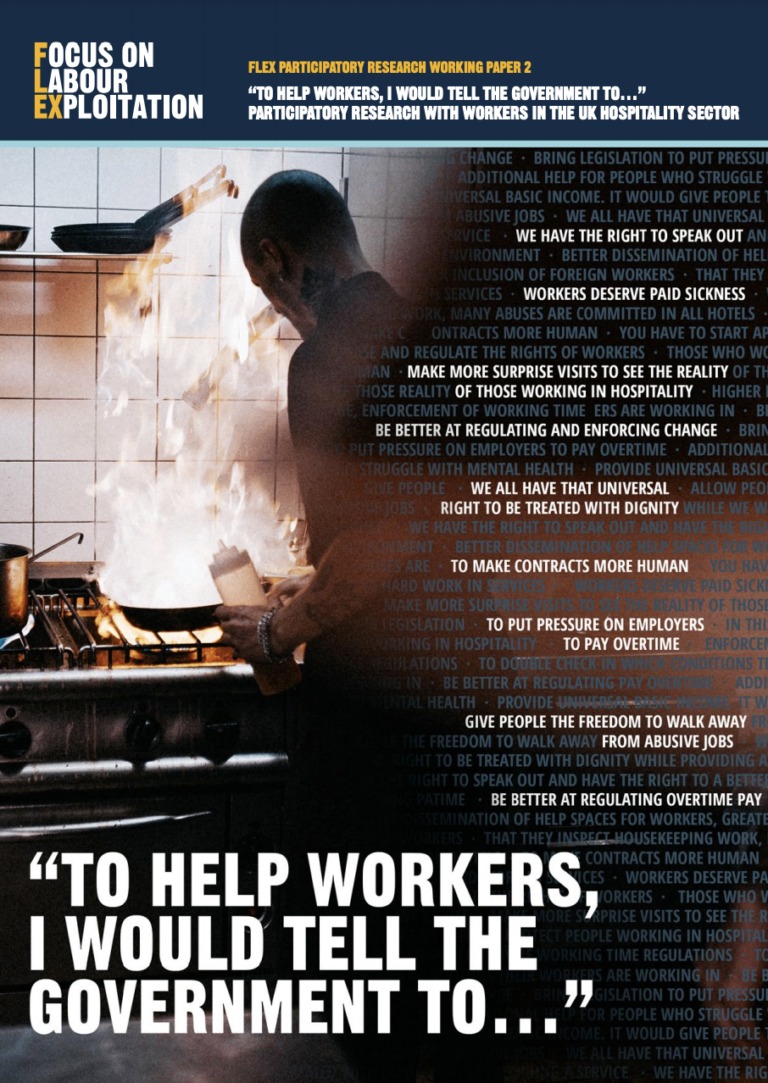
This report is the second of three working papers exploring the experiences and drivers of labour abuse and exploitation in three understudied low-paid sectors of the economy: cleaning, hospitality and the app-based courier sector. It highlights key workplace issues in the hospitality sector, finding it to be a high-risk sector for labour abuse and exploitation, with workers experiencing frequent issues with pay, inability to take time off sick, dangerous working conditions and work-related violence. Like the cleaning working paper, it uses a feminist participatory action research (FPAR) approach where workers from the sector are involved at every stage of the research process, from design to data collection and analysis.

“To help workers, I would tell the Government to…” Participatory Research with Workers in the UK Hospitality Sector - Focus on Labour Exploitation, 2021 DOWNLOAD

post

page

attachment

revision

nav_menu_item

custom_css

customize_changeset

oembed_cache

user_request

wp_block

wp_template

wp_template_part

wp_global_styles

wp_navigation

wp_font_family

wp_font_face

acf-taxonomy

acf-post-type

acf-field-group

acf-field

ai1ec_event

exactmetrics_note

Monitoring the Monitors: A Critique of PriceWaterhouseCoopers (PwC) Labour Monitoring
Publications

This report presents an assessment of the world’s largest private monitor of labour and environmental practices – PricewaterhouseCoopers (PwC). PwC performed over 6,000 factory audits in 1999, including monitoring for Nike, Disney, Walmart, the ...Read More

TAGS:
Repayment of Recruitment Fees to Workers: 4 Emerging Best Practices
Online ToolsGuidanceGood PracticesPublications

A growing number of global brands and retailers are adopting ethical recruitment policies stipulating, among other things, that all costs and fees related to labour recruitment are paid by the employer and not by the workers being recruited. Employe...Read More

TAGS: Asia
Supermarket Responsibilities for Supply Chain Workers’ Rights – Continuing Challenges in Seafood Supply Chains and the Case for Stronger Supermarket Action
Publications

International food supply chains provide employment for tens of millions of women and men around the world, demonstrating the potential for private sector actors to fight poverty and inequality. Yet far too many work in appalling conditions. The o...Read More

On exploitation, agency and child domestic work: evidence fromSouth-West Nigeria
Publications

The engagement of children in domestic work in third-party households is mostly conceived as a decision that benefits adult actors – employers, intermediaries and/or parents – at the expense of young people. Thus, child domestic workers are ...Read More

TAGS: