
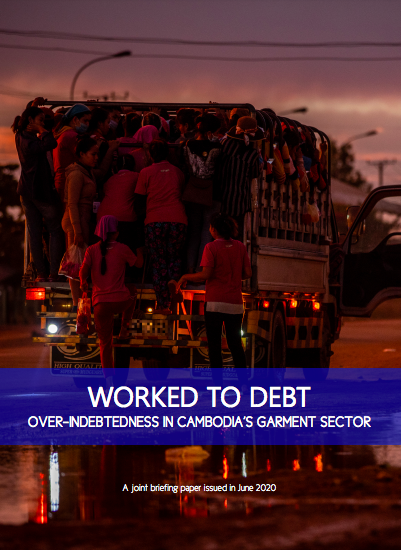
Tens of thousands of garment workers in Cambodia will struggle to repay microfinance debts during work stoppages and factory suspensions caused by COVID-19, creating a mounting human rights crisis as they struggle to feed their families and hold onto their land under immense pressure from microfinance institutions (MFIs). Without immediate debt relief, many of these workers will resort to selling their land or their homes, eating less food or taking out even more loans to repay their debts.

post

page

attachment

revision

nav_menu_item

custom_css

customize_changeset

oembed_cache

user_request

wp_block

wp_template

wp_template_part

wp_global_styles

wp_navigation

wp_font_family

wp_font_face

acf-taxonomy

acf-post-type

acf-field-group

acf-field

ai1ec_event

exactmetrics_note

Driving Behavior Change of Recruiters, Suppliers, and Job Seekers Toward Ethical Recruitment: Critical Roles of Global Buyers and Grassroots Actors
Publications

This report was prepared by Dr. Lisa Rende Taylor and Ohnmar Ei Ei Chaw, Issara Institute. Issara Institute programming in Myanmar and Thailand over the past year has focused on driving more ethical recruitment systems, down to the ‘first mileâ...Read More

On Due Diligence for EU Businesses to Address the Risk of Forced Labour in their Operations and Supply Chains
Publications

Responsible business conduct by European companies plays a crucial role in ensuring that EU policies on human rights are effectively implemented, including with regard to labour. The EU is committed to promoting the implementation of responsible bus...Read More

Freedom First Celebrating 20 Years of Progress to Combat Human Trafficking
Publications

This retrospective report provides a historical perspective on the context in which the TVPA (the Trafficking Victims Protection Act of 2000) was crafted, celebrates the major accomplishments of the United States government, and provides a view of t...Read More

Modern Slavery in Nepal: Understanding the problem and existing responses
Publications

Survey data suggests that a minimum, some 229,000 Nepali's were subject to some form of modern slavery in 2014. While some of this involved victims and offenders within Nepal itself, a significant proportion is likely to have been exploited outside ...Read More

TAGS: Asia