Human Rights Watch defends the rights of people worldwide.

We scrupulously investigate abuses, expose facts widely, and pressure those with power to respect rights and secure justice.

Human Rights Watch is an independent, international organization that works as part of a vibrant movement to uphold human dignity and advance the cause of human rights for all.

Human Rights Watch began in 1978 with the founding of its Europe and Central Asia division (then known as Helsinki Watch). Today it also includes divisions covering Africa, the Americas, Asia, Europe and Central Asia, the Middle East and North Africa, and the United States. There are thematic divisions or programs on arms; business and human rights; children’s rights; crisis and conflict; disability rights; the environment and human rights; international justice; lesbian, gay, bisexual, and transgender rights; refugee rights; and women’s rights.

The organization maintains offices in Amman, Amsterdam, Beirut, Berlin, Bishkek, Brussels, Chicago, Geneva, Goma, Hong Kong, Johannesburg, Kiev, Kinshasa, London, Los Angeles, Miami, Moscow, Nairobi, New York, Paris, San Francisco, São Paulo, Seoul, Silicon Valley, Stockholm, Sydney, Tokyo, Toronto, Tunis, Washington DC, and Zurich, and field presences in more than 50 other locations globally.

Human Rights Watch is an independent, nongovernmental organization, supported by contributions from private individuals and foundations worldwide. It accepts no government funds, directly or indirectly.
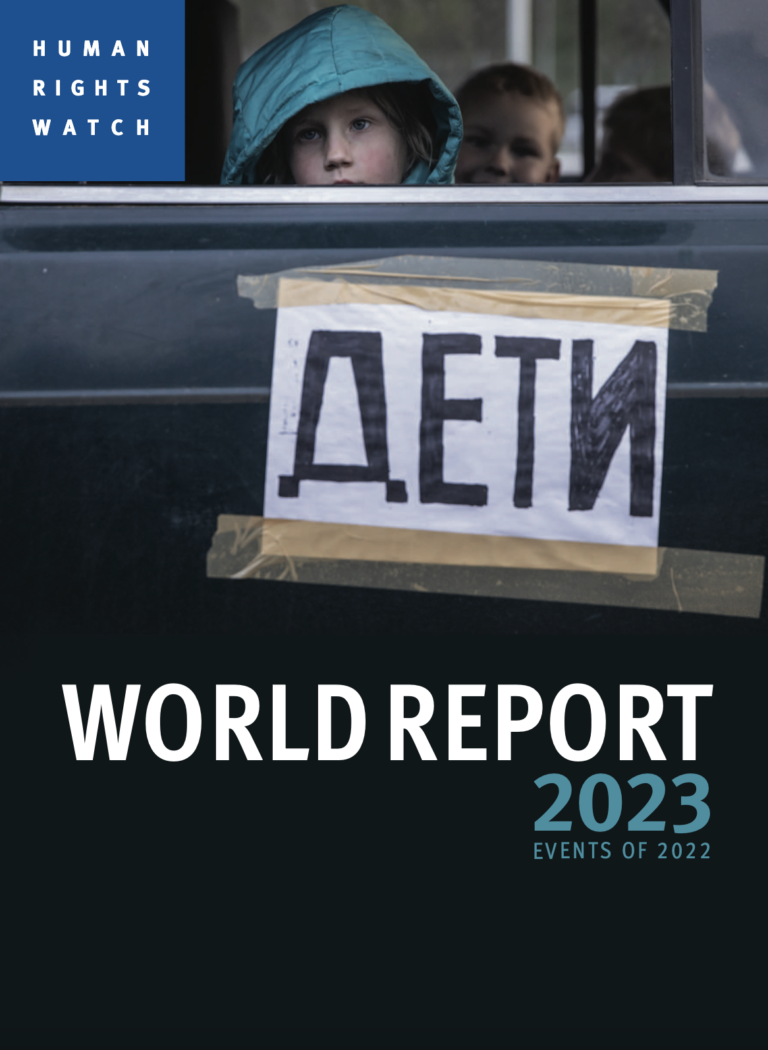
World Report 2023 - HRW, 2023 DOWNLOAD

post

page

attachment

revision

nav_menu_item

custom_css

customize_changeset

oembed_cache

user_request

wp_block

wp_template

wp_template_part

wp_global_styles

wp_navigation

wp_font_family

wp_font_face

acf-taxonomy

acf-post-type

acf-field-group

acf-field

ai1ec_event

exactmetrics_note

Business and Human Rights Navigating the legal landscape
Publications

Rapid change in the legal landscape for business with regards to human rights has profound implications for how businesses across the globe approach human rights issues. Multinational companies are having to navigate increasingly complex human right...Read More

Child Labour Platform: Recommendations for companies
Publications

This compilation includes examples of approaches that multiple companies in the textile and garments, cocoa, tourism and/or mining sectors have adopted to prevent and remediate child labour. These examples were identified on the basis of informati...Read More

Supply Chain Risk Report: Child and forced labour in Canadian consumer products
Publications

The report looks at Canada’s connection to the issues of human trafficking and forced and child labour, by cross-referencing recent data on Canadian imports with the U.S. Department of Labour’s List of Goods Produced by Child Labour or Forced Lab...Read More

Eliminating child labour in fisheries and aquaculture – Promoting decent work and sustainable fish value chains
Publications

Worldwide, the majority of child labour is concentrated in the agricultural sector, including fisheries and aquaculture. This brief provides an overview of children’s engagement in child labour in fisheries and aquaculture, the risks they are ex...Read More