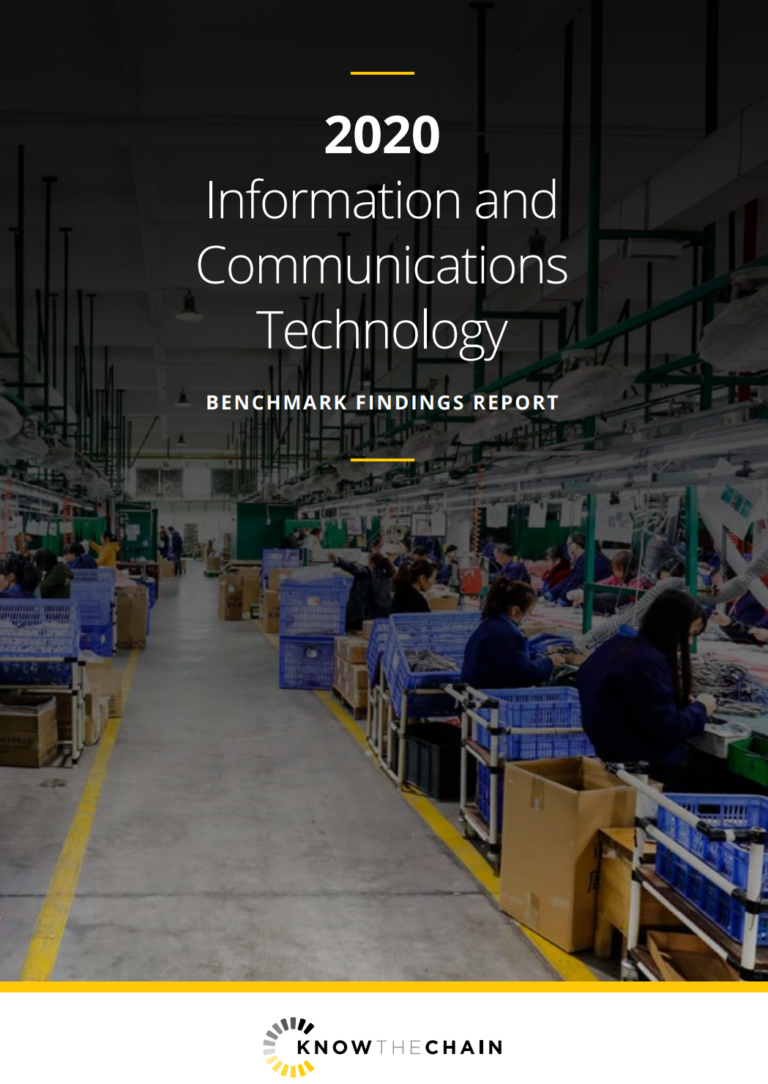
The global electronics sector is comprised of powerful corporations—the 49 largest information communications and technology (ICT) companies have a combined market capitalization of US $5 trillion and combined annual profits of almost US$1 trillion. This brings with it a duty to prevent and address forced labor in the ICT sector’s supply chains, particularly when crises such as Covid-19 exacerbate factors that render workers vulnerable to forced labor.

This report analyzes the disclosure and performance of 49 companies against seven benchmark themes, and it provides good practice examples and recommendations for companies as well as recommendations for investor action. It also highlights the nature of forced labor risks in the ICT sector and explores the role of industry associations. Finally, it shines a light on changes in company practices over time and highlights how companies address forced labor risks in the lower tiers of their supply chains.

2020 ICT Benchmark Findings Report - KnowTheChain, 2020 DOWNLOAD

post

page

attachment

revision

nav_menu_item

custom_css

customize_changeset

oembed_cache

user_request

wp_block

wp_template

wp_template_part

wp_global_styles

wp_navigation

wp_font_family

wp_font_face

acf-taxonomy

acf-post-type

acf-field-group

acf-field

ai1ec_event

exactmetrics_note

‘Made in Japan’ and the cost to migrant workers
Publications

Report on migrant garment workers in Japan’s state-supported Technical Internship Training Program (TITP) are subjected to widespread labour violations including poverty pay, debt bondage, enforced overtime, and inadequate and crowded living and w...Read More

FTSE 100 & the UK Modern Slavery Act: From Disclosure to Action
Publications

In 2015, the UK Government introduced the Modern Slavery Act (MSA), which requires certain companies publish an annual statement detailing what steps they have taken to tackle modern slavery, both in their operations and in their supply chains. Busin...Read More

Access to protection and remedy for victims of human trafficking for the purpose of labour exploitation in Belgium and the Netherlands
Publications

According to the latest ILO global estimates, 25 million people are victims of forced labour. This issue concerns all regions in the world. UN Sustainable Development Goal 8 on Decent Work and Economic Growth includes a target 8.7 for which the inte...Read More

Looking for a Quick Fix – How Weak Social Auditing is Keeping Workers in Sweatshops
Publications

This report from 2005 researches the weaknesses of social auditing. Social audits to check working conditions in production facilities emerged in the mid-1990s after a number of high profile companies were widely scrutinized for substandard working ...Read More