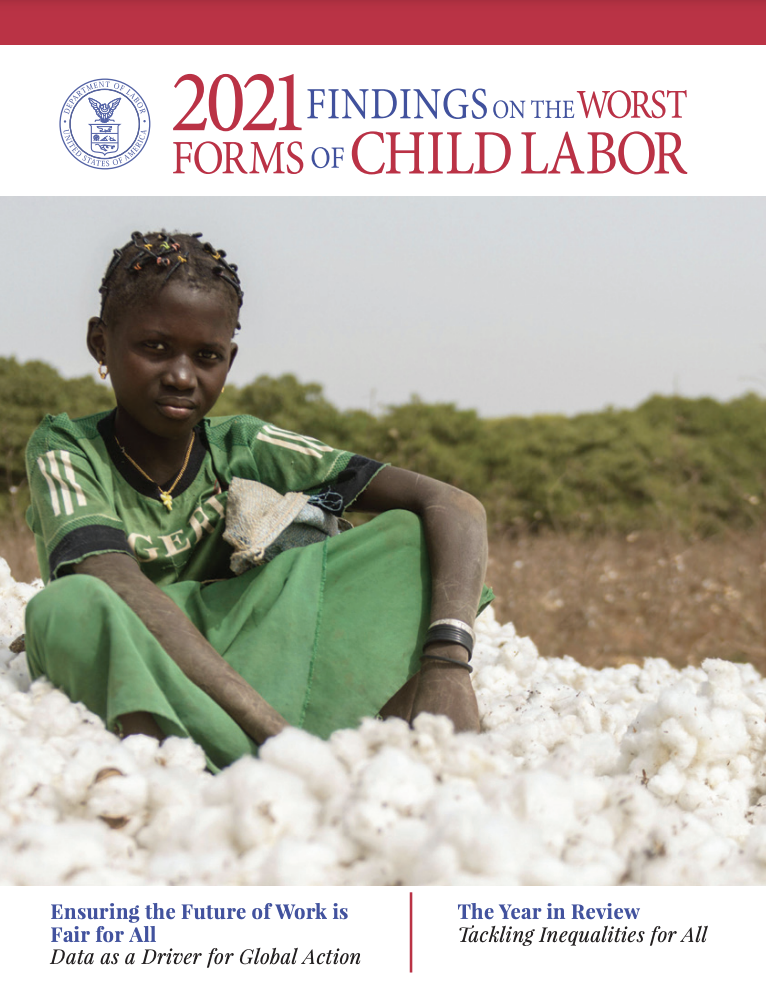
The U.S. Department of Labor has prepared the 2021 Findings on the Worst Forms of Child Labor in accordance with the Trade and Development Act of 2000 (TDA). (1) The TDA set forth the requirement that a country must implement its commitments to eliminate the worst forms of child labor for the President of the United States to designate the country a beneficiary developing country under the Generalized System of Preferences (GSP) program (subject to an exception if designation is in the national economic interest of the United States). (2; 3) The TDA also mandated that the President submit to the United States Congress the Secretary of Labor’s findings with respect to each “beneficiary country’s implementation of its international commitments to eliminate the worst forms of child labor.” (1) ILAB carries out this responsibility on behalf of the Secretary.

Country Coverage

This report covers 119 independent countries and 15 non-independent countries and territories designated as GSP beneficiaries. This includes former GSP recipients who have negotiated free-trade agreements with the United States. (4) Because the population of children is extremely small (fewer than 50) or non-existent in the British Indian Ocean Territory, Heard Island and McDonald Islands, and the Pitcairn Islands, the report does not contain a discussion of these three non-independent countries and territories. The 2021 report presents information on child labor and the worst forms of child labor, and efforts to eliminate this exploitation in the remaining 119 countries and 12 nonindependent countries and territories. The use of “countries” in this report includes territories, and because the report focuses on government efforts, non-independent countries and territories are classified by their associated regions.

2021 Findings on the Worst Forms of Child Labor - United States Department of Labor, 2022 DOWNLOAD

post

page

attachment

revision

nav_menu_item

custom_css

customize_changeset

oembed_cache

user_request

wp_block

wp_template

wp_template_part

wp_global_styles

wp_navigation

wp_font_family

wp_font_face

acf-taxonomy

acf-post-type

acf-field-group

acf-field

ai1ec_event

exactmetrics_note

TRADING AT ANY COST: DUTCH GOVERNMENT PUTS ECONOMIC INTERESTS BEFORE PROTECTING HUMAN RIGHTS
Publications

For over a decade, the Netherlands has put its trading interests above its duty to protect against human rights abuse by companies operating under its jurisdiction. This report, based on Amnesty International research conducted between March and ...Read More

TAGS:
Updated Indicators: Laundering of proceeds from human trafficking for sexual exploitation
Publications

This Operational Alert updates FINTRAC’s 2016 Operational Alert “Indicators: The laundering of illicit proceeds from human trafficking for sexual exploitation” with additional indicators in support of Project Protect to assist reporting entiti...Read More

Human Trafficking and Risky Migration Routes Data Collection: A case study from Kenya
Publications

In August, 2019, Stop the Traffik Kenya (STTK) and Freedom Collaborative (FC), a project operated by Liberty Shared, launched a data collection effort with civil society organisations (CSOs) in Kenya to report known human trafficking and high-risk m...Read More

TAGS: Africa
Public Procurement and Human Rights Due Diligence to Achieve Respect for Labour Rights Standards in Electronics Factories: A Case Study of the Swedish County Councils and the Dell Computer Corporation
Publications

A sector-specific case example ‘The Swedish County Councils’ in-depth review of the human rights policies and due diligence of its IT contractor, Atea, and subcontractor, Dell, to respect workers’ rights has helped increase both companies’ ca...Read More