
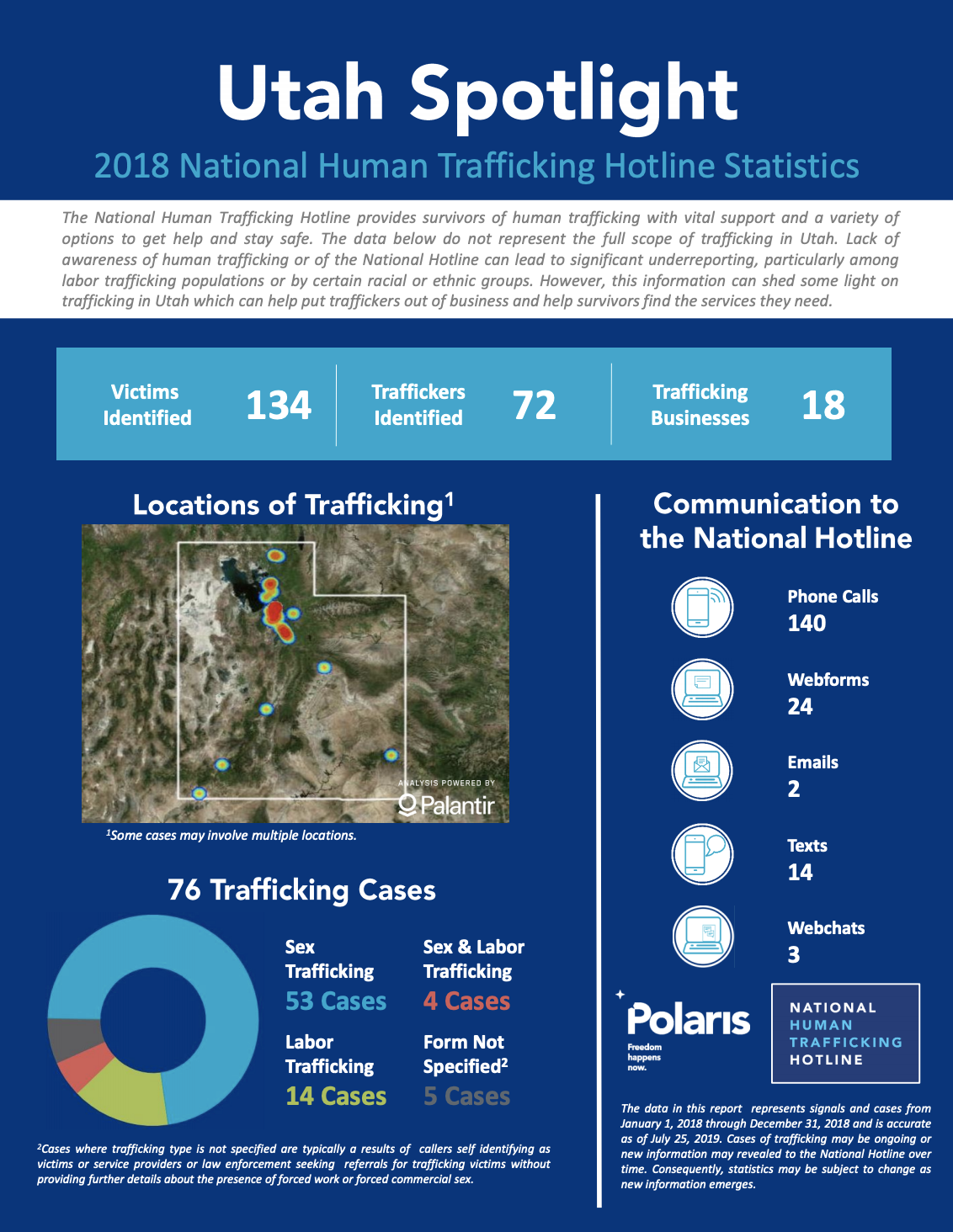
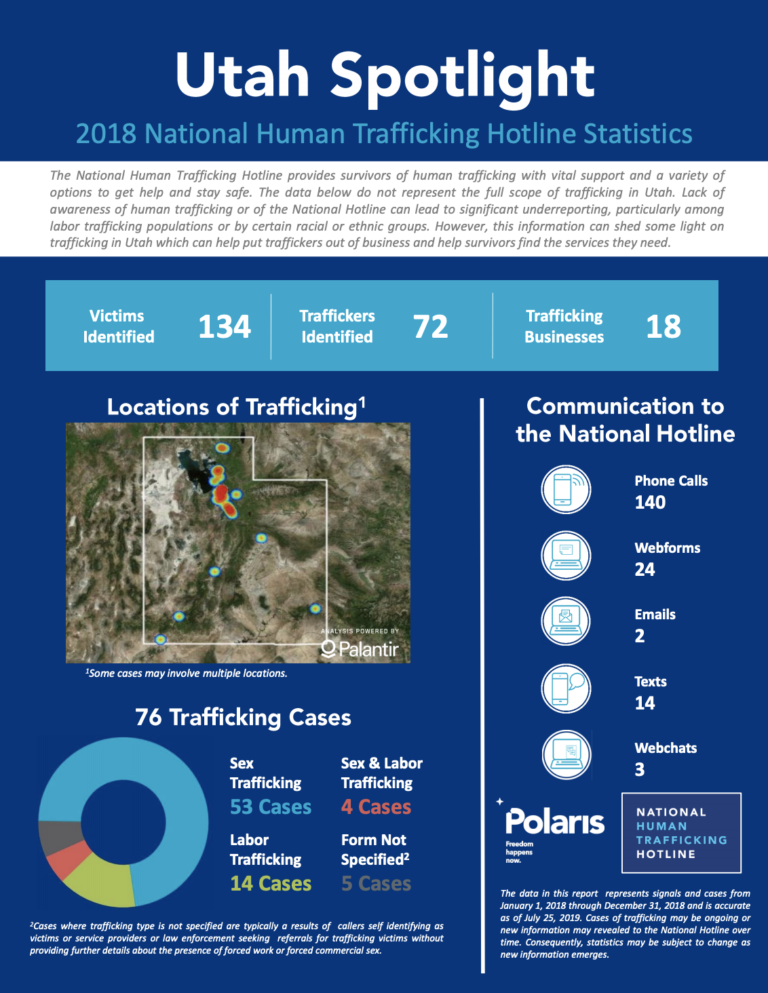
The data in this report represents signals and cases from January 1, 2018 through December 31, 2018 and is accurate as of July 25, 2019. Cases of trafficking may be ongoing or new information may revealed to the National Hotline over time. Consequently, statistics may be subject to change as new information emerges.

You can find the report infographic below.

National Hotline 2018 Utah State Report - National Human Trafficking Hotline, 2019 DOWNLOAD

post

page

attachment

revision

nav_menu_item

custom_css

customize_changeset

oembed_cache

user_request

wp_block

wp_template

wp_template_part

wp_global_styles

wp_navigation

wp_font_family

wp_font_face

acf-taxonomy

acf-post-type

acf-field-group

acf-field

ai1ec_event

exactmetrics_note

UK Modern Slavery Helpline: Annual Assessment 2017
Publications

The UK-wide Modern Slavery Helpline and Resource Centre was established in October 2016 to provide victims, the public, statutory agencies and businesses with access to information and support on a 24/7 basis. Operated by Unseen, in its first full...Read More

Transforming our world: the 2030 Agenda for Sustainable Development
Publications

The agenda is a plan of action for people, planet and prosperity. It seeks to strengthen uni- versal peace in larger freedom. The agenda recognizes that eradicating poverty in all its forms and dimensions, including extreme poverty, is the greatest g...Read More

Antislavery in Domestic Legislation Country Reports
Standards & Codes of ConductGood PracticesLegislationPublications

Research and analysis conducted by Katarina Schwarz (University of Nottingham) and Jean Allain (Monash University). To assess the extent to which slavery and related forms of human exploitation have been prohibited in domestic law, this project ...Read More

TAGS: Global
Fishing For Data
Publications

Marine fisheries are critical resources for coastal developing countries. They are also difficult to manage sustainably. Almost a third of global fish stocks are degraded from overfishing, and a further 60% are ‘fully exploited’ (FAO, 2016). Ille...Read More