
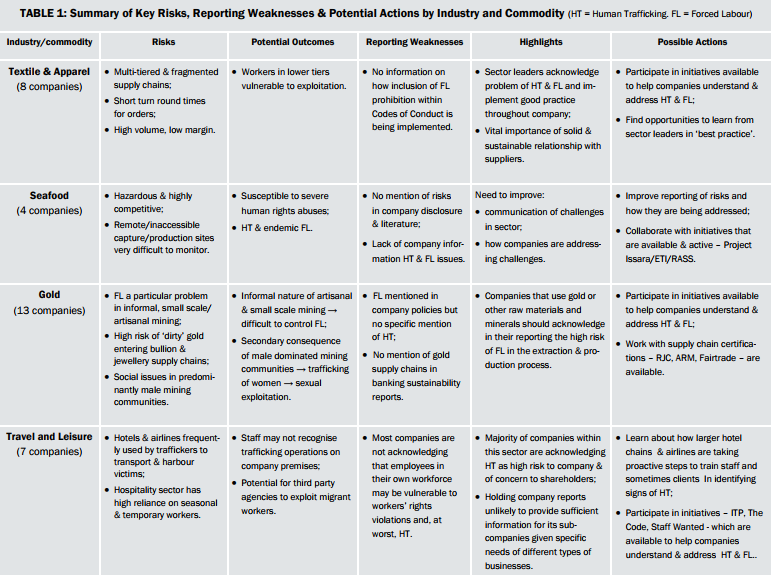
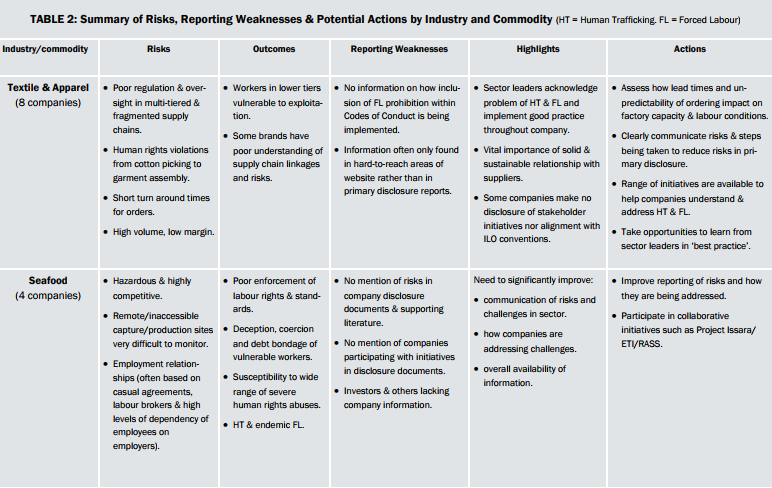
As shareholders of a company, investors have the power and incentive to influence company behaviours, and can have considerable influence over the way in which a company addresses and mitigates its risks in the area of human trafficking and forced labour. This report provides investors with a selection of representative industry examples and case studies that will enable them to be more conversant with, and have greater understanding of, the nature of human trafficking and forced labour risks in various sectors. Advice and guidance is given to investors and businesses on how these risks can be addressed and companies can meet their corporate responsibilities.

Forced Labour, Human Trafficking and the FTSE 100 - A Review of Company Disclosure and Recommendations for Investor Engagement - Finance Against Trafficking, 2015 DOWNLOAD

post

page

attachment

revision

nav_menu_item

custom_css

customize_changeset

oembed_cache

user_request

wp_block

wp_template

wp_template_part

wp_global_styles

wp_navigation

wp_font_family

wp_font_face

acf-taxonomy

acf-post-type

acf-field-group

acf-field

ai1ec_event

exactmetrics_note

NetClean Report 2019
Publications

NetClean Report 2019 is about live-streamed child sexual abuse, storage of child sexual abuse material and how emerging technologies affect this crime. It is also about businesses' response to child sexual abuse material in their IT environment, and...Read More

Global Flagship Programme Implementation
Publications

The objective of the IPEC+ Global Flagship Programme – in line with target 8.7 of the 2030 Sustainable Development Agenda, adopted by the United Nations in 2015 – is to provide ILO leadership in global efforts to eradicate all forms of child la...Read More

The Recycling Industry Addressing Child Labour and other Decent Work Challenges
Publications

While industrial recycling is squarely situated in the formal sector of the economy, the upstream segments of the recycling supply chain may reach deep into the informal sector, intersecting with the centuries-old occupation of waste picking. In man...Read More

Too Weak for the Job: Corporate Codes of Conduct, Non-Governmental Organizations and the Regulation of International Labour Standards
Publications

The shift of economic production from higher labour standard regimes in the global North to lower standard regimes in the South is undermining enforcement of global labour standards. Responding to criticisms from the ‘anti-sweatshop’ movement, c...Read More