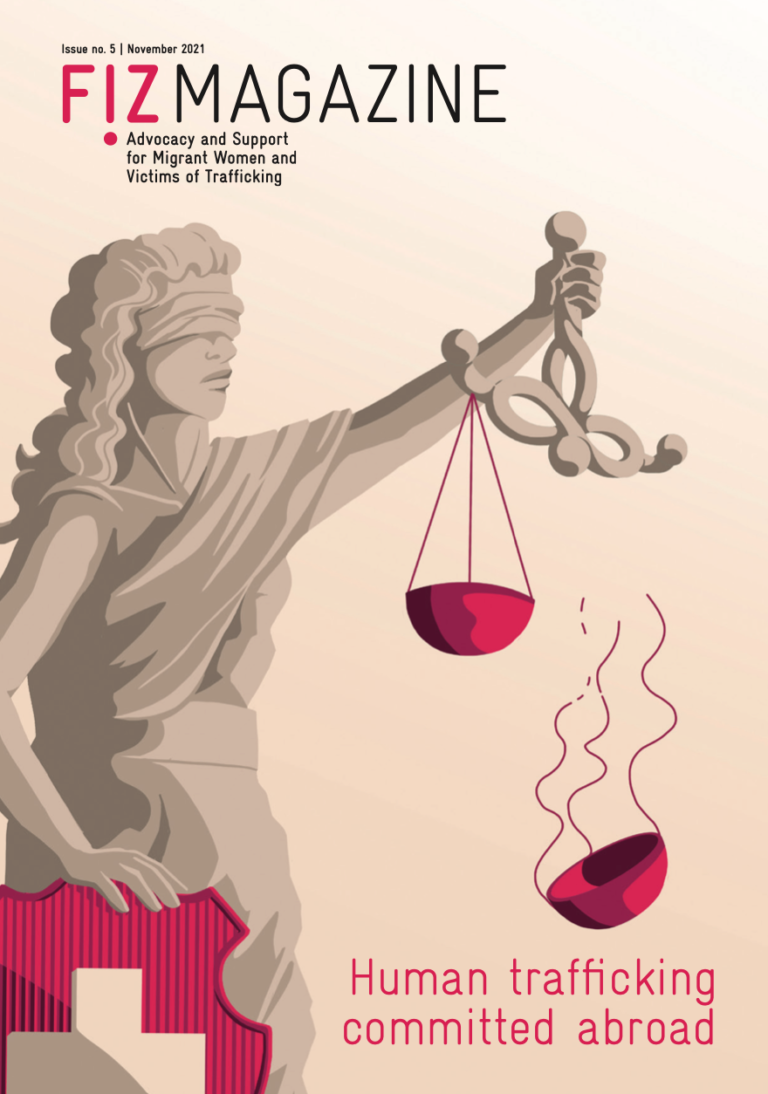
Switzerland likes to be the exception. Unfortunately, this is also the case when it comes to the direct application of the Council of Europe Anti-Trafficking Convention. Whereas the Convention states clearly that the access to support services must be guaranteed independently of the place of exploitation, the Swiss Victim Aid Act denies access to victim aid to anyone who did not possess a residency in Switzerland at the time of the exploitation and has been exploited abroad. For foreign victims of trafficking, this means that technically they only have access to support if their exploitation took place in Switzerland, thus excluding a large number of victims currently living in Switzerland or going through the asylum process in the country.

Since this situation is not only against international human rights law but also has a direct impact on FIZ’s daily work and its clients, they decided to dedicate this year’s magazine to this topic in order to bring this injustice to the forefront and initiate change. This issue also includes a conversation with lawyer and human trafficking expert Julia Planitzer, where she discusses the discrepancy between mandatory international law and the reality in Switzerland. The magazine is available in English and French.

Human trafficking committed abroad_English - FIZ Magazine, November 2021 DOWNLOAD
Human trafficking committed abroad_French - FIZ Magazine, November 2021 DOWNLOAD

post

page

attachment

revision

nav_menu_item

custom_css

customize_changeset

oembed_cache

user_request

wp_block

wp_template

wp_template_part

wp_global_styles

wp_navigation

wp_font_family

wp_font_face

acf-taxonomy

acf-post-type

acf-field-group

acf-field

ai1ec_event

exactmetrics_note

The Global Business of Forced Labour: Report of Findings
Publications

This report presents the findings from the Global Business of Forced Labour project. The project investigates the business models of forced labour in global agricultural supply chains. Over two years the project systematically mapped the business ...Read More

Sextortion: Findings from a Survey of 1,631 Victims
Publications

Janis Wolak and David Finkelhor Sextortion is defined as threats to expose a sexual image in order to make a person do something or for other reasons, such as revenge or humiliation. In an effort to better understand the threat of sextortion and ...Read More

Driving Behavior Change of Recruiters, Suppliers, and Job Seekers Toward Ethical Recruitment: Critical Roles of Global Buyers and Grassroots Actors
Publications

This report was prepared by Dr. Lisa Rende Taylor and Ohnmar Ei Ei Chaw, Issara Institute. Issara Institute programming in Myanmar and Thailand over the past year has focused on driving more ethical recruitment systems, down to the ‘first mileâ...Read More

Human Suffering in Italy’s Agricultural Value Chain
Publications

This report is one of a series of case studies to supplement the global campaign report, Ripe for Change, drawing attention to the plight of specific groups of small-scale farmers or workers in international food value chains and/or promoting succes...Read More