
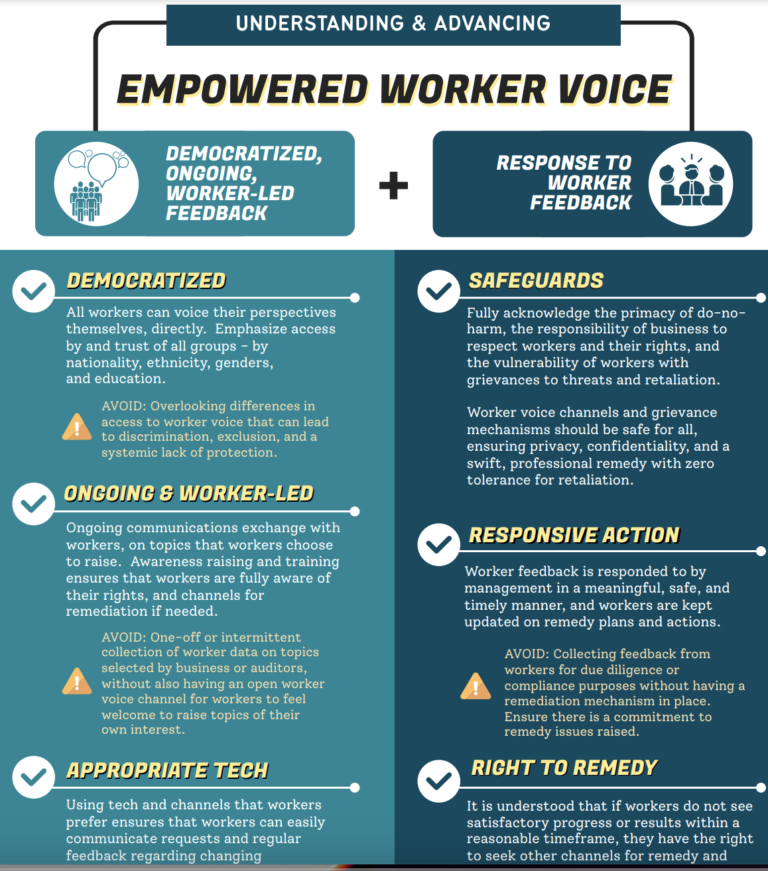
Over the past several months, in Issara’s ongoing engagement with brands and retailers, business associations, and environmental sustainability colleagues, Issara has been asked many times what worker voice is. It is widely observed at this point that there are more and more programs and technologies emerging that refer to themselves as “worker voice,” but then also a sneaking suspicion that not all are. So how to understand what worker voice is, why it is important for both workers and business, and what harm can be done by positioning a program as worker voice when it really is not?

Understanding and Advancing Empowered Worker Voice - Issara Institute, 2022 DOWNLOAD

post

page

attachment

revision

nav_menu_item

custom_css

customize_changeset

oembed_cache

user_request

wp_block

wp_template

wp_template_part

wp_global_styles

wp_navigation

wp_font_family

wp_font_face

acf-taxonomy

acf-post-type

acf-field-group

acf-field

ai1ec_event

exactmetrics_note

Anti-Human Trafficking Authentication Criteria Company-level and Site-Level
Guidance

The following criteria can be used by any organization to help it design an effective and transparent system for preventing human trafficking in its operations and those of its supply chain. It can also be used by an organization or an independent t...Read More

TAGS: Global
Trafficking and Exploitation Strategy – Third Annual Progress Report and Strategy Review
GuidanceStandards & Codes of Conduct

The Human Trafficking and Exploitation (Scotland) Act 2015 (“the Act”) introduced new offences, gave police and prosecutors additional powers to tackle traffickers, raised the maximum penalty for trafficking to life imprisonment, and placed supp...Read More

Ending forced labour by 2030: A review of policies and programmes
Guidance

The international community clearly faces an immense challenge in honouring the global commitment made in Target 8.7 of the Sustainable Development Goals to end all forms of forced labour by 2030 and to end the forced labour of children, along with ...Read More

How Can I Manage the Risk of Modern Slavery in My Supply Chain? GFEMS Highlights Three Promising Forced Labor Risk Detection Tools
Guidance

The COVID-19 pandemic has increased workers’ vulnerability to modern slavery across global apparel and manufacturing supply chains1. In addition to exacerbating risks to workers, the pandemic has increased consumers’ visibility on where and...Read More