
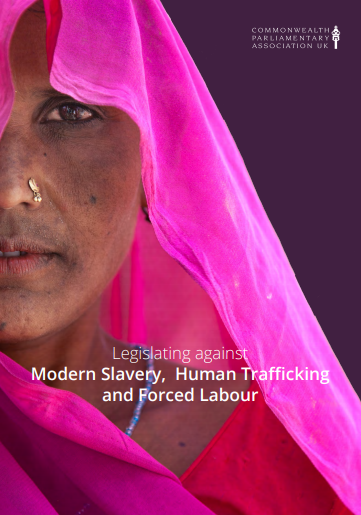
This e-handbook is a comprehensive guide for parliamentarians and parliamentary officials on legislating effectively against modern slavery-related crimes.

The e-Handbook covers topics such as:

  • gathering cross-party support;
  • creating and reviewing legislation;
  • engaging civil society; and
  • the role of parliament at the implementation stage

Over 50 experts from around the Commonwealth have contributed to the resource, including parliamentarians, legislative drafters and leading modern slavery lawyers.

Legislating Against Modern Slavery, Human Trafficking & Forced Labour - CPA UK, 2018 DOWNLOAD

post

page

attachment

revision

nav_menu_item

custom_css

customize_changeset

oembed_cache

user_request

wp_block

wp_template

wp_template_part

wp_global_styles

wp_navigation

wp_font_family

wp_font_face

acf-taxonomy

acf-post-type

acf-field-group

acf-field

ai1ec_event

exactmetrics_note

ETI’s Base Code Guidance: Modern slavery – practical guidance for brands and retailers
Guidance

This guide developed by Ethical Trade Initiative (ETI) will help businesses understand key concepts, legal definitions and their responsibility to tackle modern slavery. It provides examples and practical steps to assist companies in applying ETI B...Read More

TAGS: Global
Council guide to Tackling Modern Slavery
Guidance

In 2017, the Local Government Association (LGA) worked with the Office of the Independent Anti-Slavery Commissioner to develop the first council guidance on tackling modern slavery. The development of the guide followed a presentation by the first C...Read More

TAGS: Europe
Relentless Resilience: Addressing Gender-Based Violence through Grassroots Excellence
Guidance

Relentless Resilience is a Beijing +25 Parallel Report that calls for holistic change to address the root causes of gender-based violence (gender inequity, systemic racism, colonialism, ableism, trans/homophobia, capitalism, etc.) and societal power...Read More

Modern Slavery: Deceptive and Coercive Recruitment
GuidanceGood PracticesGraphics & Infographics

Workers are recruited via unlicensed third-party agencies. Use of unlicensed third-party agencies increases the risk of labor exploitation. Workers pay for recruitment, employment or repatriation fees. Costs associated with employment can place ...Read More

TAGS: Global