
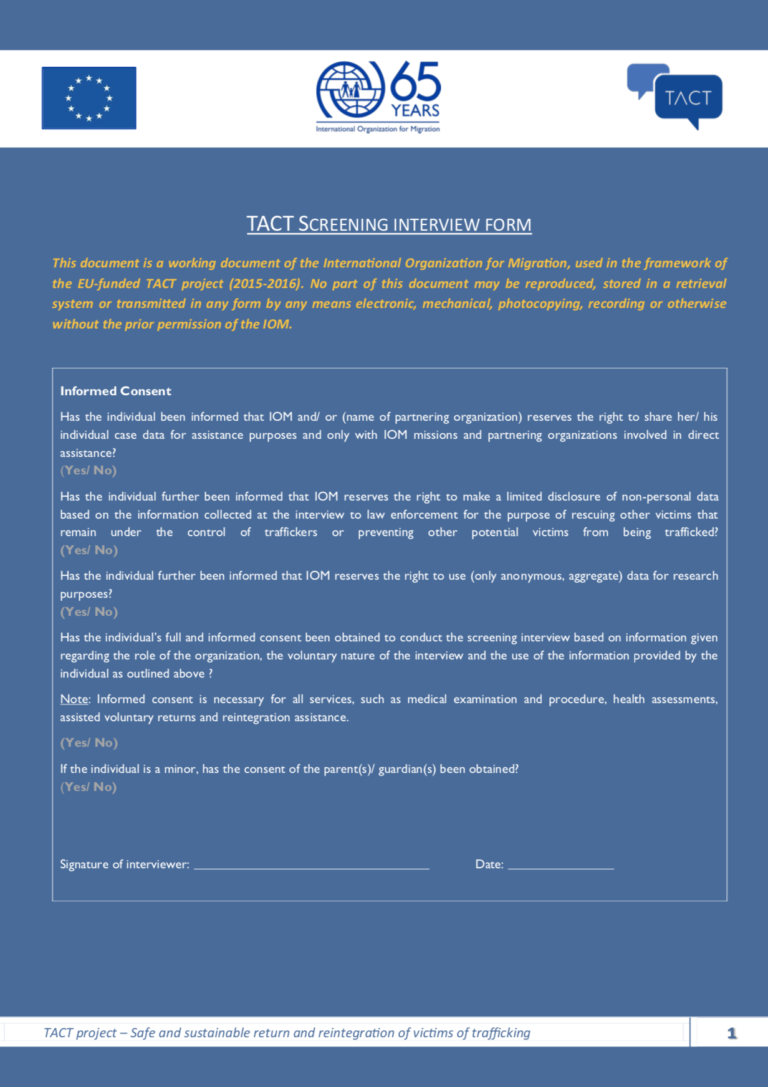
The Screening Interview Form is a document enabling relevant stakeholders to identify the beneficiary as a victim by gathering information related to the trafficking process. It should be completed by one person (case-worker) in coordination with partners in both countries of origin / destination.

This document is a working document of the International Organization for Migration, used in the framework of the EU-funded TACT project (2015-2016).

Screening Interview Form DOWNLOAD

post

page

attachment

revision

nav_menu_item

custom_css

customize_changeset

oembed_cache

user_request

wp_block

wp_template

wp_template_part

wp_global_styles

wp_navigation

wp_font_family

wp_font_face

acf-taxonomy

acf-post-type

acf-field-group

acf-field

ai1ec_event

exactmetrics_note

Adult Modern Slavery Protocol for Local Authorities: NRM Process Guide for Local Authorities
Guidance

This guide accompanies the Local Authorities’ Referral Process Pathway for Adult Victims of Modern Slavery. This guide provides non-prescriptive steps to follow when a potential victim of human trafficking or modern slavery is identified. It shoul...Read More

TAGS: Europe
Trafficking in Human Beings – Sexual Exploitation
Guidance

Trafficking in human beings is defined as a situation whereby a person’s predicament is used to trap them in an exploitative situation. This can take various forms and occurs in different areas: • Exploitative employment relationships â€...Read More

TAGS: Europe
Ending forced labour by 2030: A review of policies and programmes
Guidance

The international community clearly faces an immense challenge in honouring the global commitment made in Target 8.7 of the Sustainable Development Goals to end all forms of forced labour by 2030 and to end the forced labour of children, along with ...Read More

Recovering Rights Series: Business and Human Rights in a Just Recovery
COVID-19 resourcesGuidance

This brief is part of a series highlighting how we can leverage the commitments governments have made to guarantee human rights to steer us towards a just recovery from the COVID-19 pandemic. The pandemic response has demanded a greater role for ...Read More