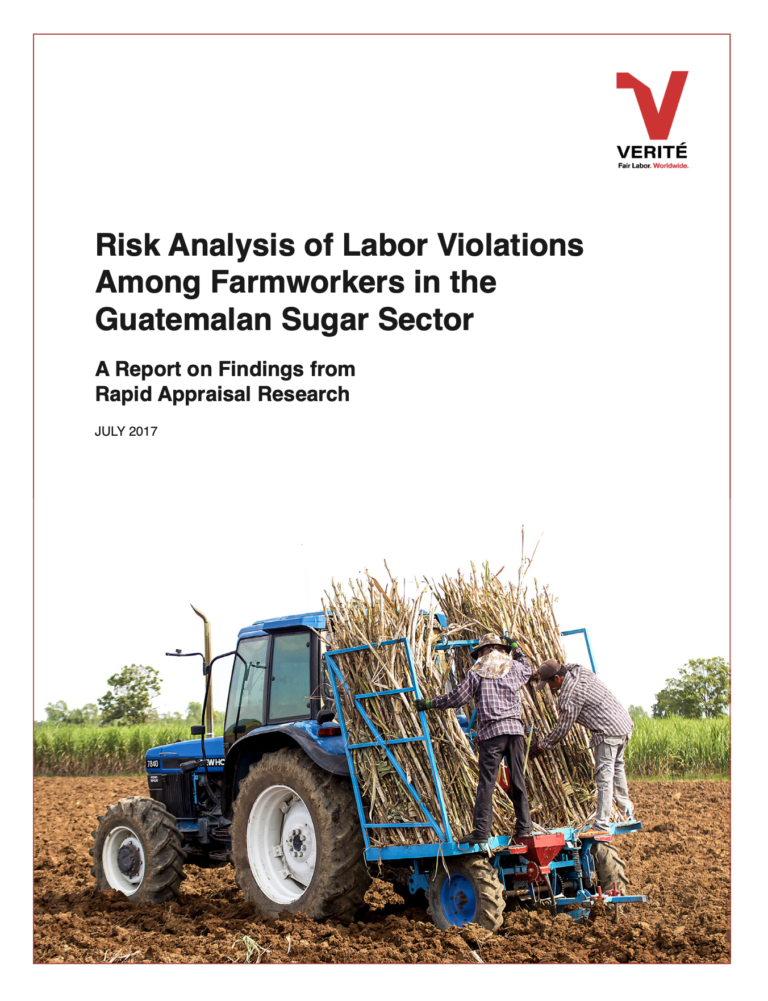
Rapid appraisal research was carried out by Verité and REACH (Research-Education- Action-Change) on labour conditions in Guatemalan sugarcane production in late 2016. Researchers conducted a literature review, expert consultations, unstructured life story interviews with three workers, and in-depth survey interviews with 38 workers who performed a range of tasks on sugar plantations, including harvesting sugarcane. Verité found indicators of labour trafficking and evidence of recruitment abuses, child labour, restrictions on workers’ right to freedom of association, gender-based discrimination, wage and hour violations, threats to workers’ health and safety, inhumane living conditions, and negative impacts on communities surrounding sugar plantations. Verité has developed actionable recommendations for companies seeking to improve working conditions in the sugar sector, as well as recommendations for the Guatemalan government.

Risk Analysis of Labor Violations Among Farmworkers in the Guatemalan Sugar Sector - Verité, 2017 DOWNLOAD

post

page

attachment

revision

nav_menu_item

custom_css

customize_changeset

oembed_cache

user_request

wp_block

wp_template

wp_template_part

wp_global_styles

wp_navigation

wp_font_family

wp_font_face

acf-taxonomy

acf-post-type

acf-field-group

acf-field

ai1ec_event

exactmetrics_note

Child Exploitation Disruption Toolkit
Guidance

This toolkit has been developed to support frontline practitioners to safeguard children and young people under the age of 18 from sexual and criminal exploitation. This includes social workers, police officers, housing officers, education staff, he...Read More

TAGS: Europe
National Referral Mechanisms – Joining Efforts to Protect the Rights of Trafficked Persons: A Practical Handbook
GuidanceGood Practices

National referral mechanisms (NRMs) are the institutional mechanisms that help states identify human trafficking victims and ensure their protection. This handbook provides a guidance model which all OSCE participating States can adapt and apply wit...Read More

Implementation of the Non-Punishment Principle
Guidance

In the report, the Special Rapporteur analyses current challenges in the implementation of the principle of non-punishment. The principle of non-punishment constitutes the cornerstone of an effective protection of the rights of victims of traffickin...Read More

Addressing Forced Labor and other Modern Slavery Risks: A Toolkit for Small and Medium-Sized Suppliers
GuidanceGraphics & Infographics

This toolkit aims to help companies that work in corporate supply chains to quickly identify areas of their business which carry the highest risk of modern slavery and develop a simple plan to prevent and address any identified risks. It is designed...Read More