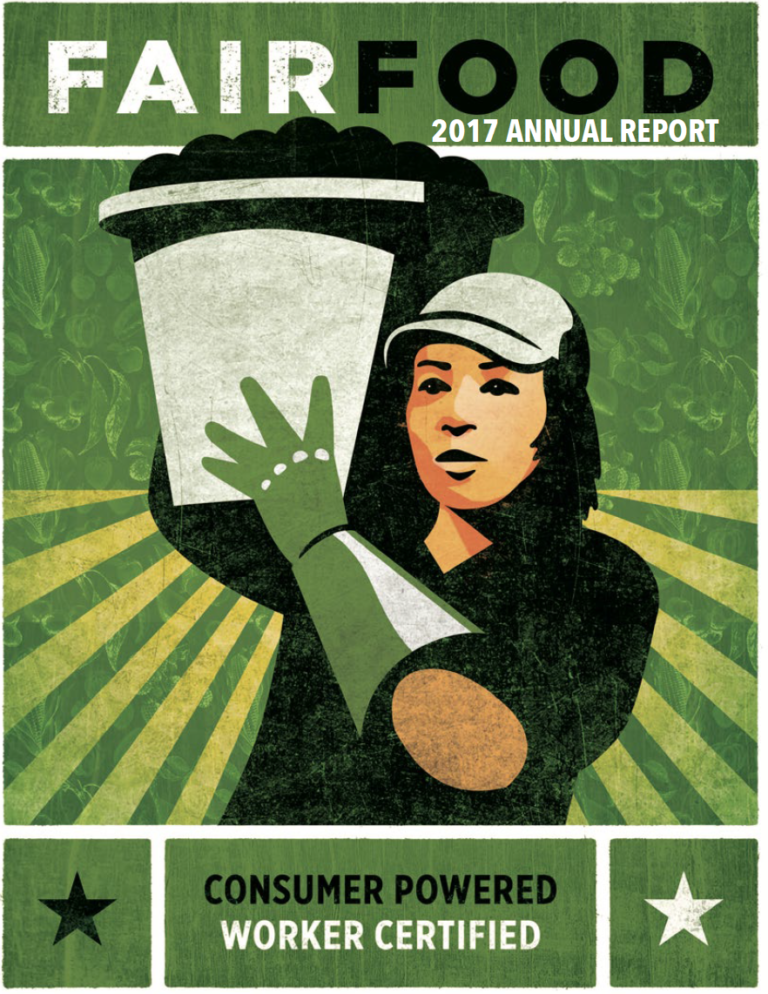
This is the fourth report of the Fair Food Standards Council on the state of the Fair Food Program. It provides the most recent results and analysis from Seasons 5 and 6 of the Program’s implementation. However, unlike past reports, the 2017 version also tracks the trajectory of the Fair Food Program — the unfolding story of increasing compliance through the constant back and forth of audits, investigations, and corrective actions — over the course of all six seasons of the Program’s operation. It is a comprehensive and transparent look at the structure and function of the Fair Food Program and the constant ebb and flow of change that has been brought about in the fields of Florida and six other states. Through carefully detailed quantitative and qualitative analysis, the report tracks a fundamental re-shaping of an entire industry and, in the process, the forging of a model that is already bringing change to many more workers here in the US and overseas.

The Fair Food Program 2017 Annual Report DOWNLOAD

post

page

attachment

revision

nav_menu_item

custom_css

customize_changeset

oembed_cache

user_request

wp_block

wp_template

wp_template_part

wp_global_styles

wp_navigation

wp_font_family

wp_font_face

acf-taxonomy

acf-post-type

acf-field-group

acf-field

ai1ec_event

exactmetrics_note

British Children Can Be Trafficked Too: Towards an Inclusive Definition of Internal Child Sex Trafficking
Publications

In research, policy and practice, internal trafficking has been long overshadowed by its international counterpart. Despite the introduction of specific legislation against internal sex trafficking, confusion remains in Britain around how this crim...Read More

Recruitment fees and related costs: What migrant workers from Cambodia, the Lao People’s Democratic Republic, and Myanmar pay to work in Thailand
Publications

Thailand has a long history of labour migration, initially as a country of origin, and more recently as a destination country. Today, Thailand is host to the largest number of migrant workers of all ASEAN member states, with approximately 2.8 millio...Read More

Child labour book series: Corporate social responsibility for farmers, No. 1: Understanding the concept of child labour
Publications

This booklet is one in a set of three booklets that aims at educating stakeholders about the problem of child labour, the national policies, legislation and strategies and the specific hazards of engagement of children in tobacco farming. Readers ...Read More

Human Suffering in Italy’s Agricultural Value Chain
Publications

This report is one of a series of case studies to supplement the global campaign report, Ripe for Change, drawing attention to the plight of specific groups of small-scale farmers or workers in international food value chains and/or promoting succes...Read More