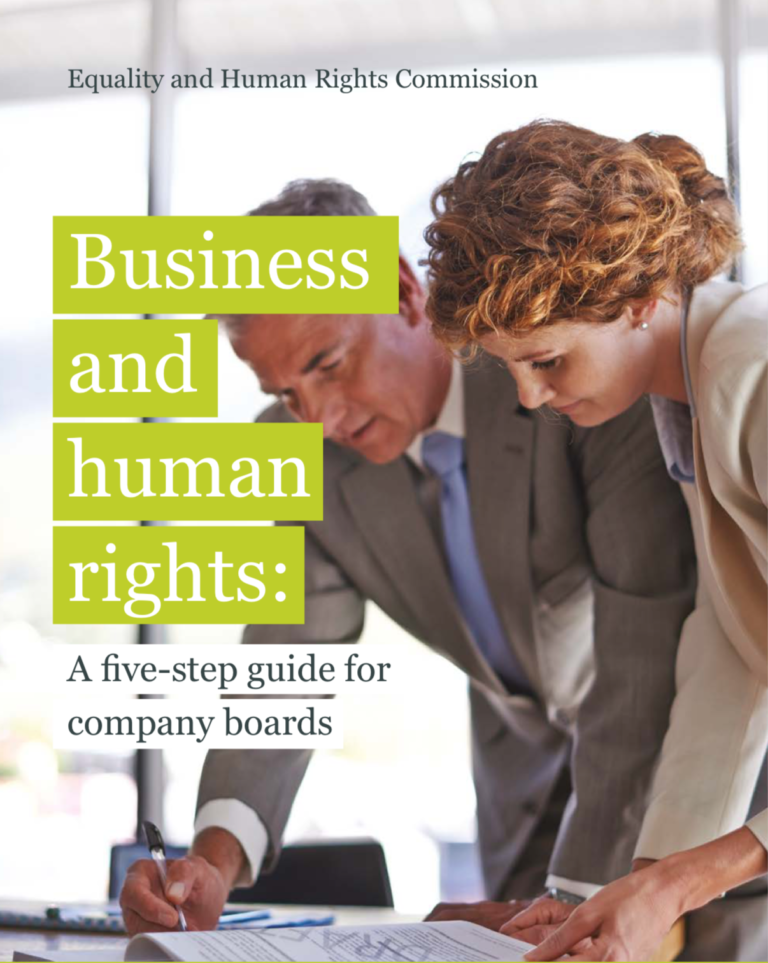
The guide is for boards of companies in the United Kingdom. It sets out five steps boards should follow to satisfy themselves that their companies identify, mitigate and report on the human rights impacts of their activities. These steps will also help boards to reflect their leadership and fiduciary duties.

The guide also provides advice on how boards can meet the UN Guiding Principles on Business and Human Rights, the global standard, which outline the role of business and governments in respecting human rights. The Guiding Principles do not create any new international legal obligations on companies, but they can help boards to operate with respect for human rights and meet their legal responsibilities set out in domestic laws. They are also supported by the UK Government.
Business and human rights: A five-step guide for company boards - Equality and Human Rights Commission, 2016 DOWNLOAD

post

page

attachment

revision

nav_menu_item

custom_css

customize_changeset

oembed_cache

user_request

wp_block

wp_template

wp_template_part

wp_global_styles

wp_navigation

wp_font_family

wp_font_face

acf-taxonomy

acf-post-type

acf-field-group

acf-field

ai1ec_event

exactmetrics_note

Trafficking Along Migration Routes to Europe: Bridging the Gap Between Migration, Asylum, and Anti-Trafficking
Guidance

The years 2015-2016 saw an unprecedented increase in the numbers of people travelling by sea and overland along the migration route to the European Union (EU), with almost one and a half million people irregularly entering EU countries. This situati...Read More

Human Trafficking: What Disaster Responders Need to Know
GuidanceGraphics & Infographics

Studies have shown that even outside of a disaster context, approximately 50% of individuals who have been trafficked saw a health professional while being trafficked. However, first responders are rarely trained to recognize these patients, despite...Read More

How Can I Manage the Risk of Modern Slavery in My Supply Chain? GFEMS Highlights Three Promising Forced Labor Risk Detection Tools
Guidance

The COVID-19 pandemic has increased workers’ vulnerability to modern slavery across global apparel and manufacturing supply chains1. In addition to exacerbating risks to workers, the pandemic has increased consumers’ visibility on where and...Read More

Shady business: Uncovering the business model of labour exploitation
Guidance

Edited by Anniina Jokinen and Natalia Ollus. Labour exploitation and trafficking can be seen as direct consequences of global inequality. Poverty, a lack of social or economic opportunities, disparities in income and the standard of living, oppr...Read More