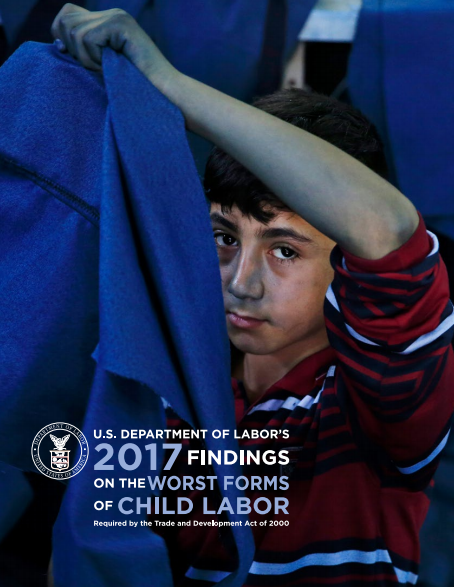
The Findings on the Worst Forms of Child Labor, mandated by the Trade and Development Act of 2000, is the most comprehensive research product on the state of child labour worldwide. This year, the report uses more stringent criteria to assess the efforts of 132 countries and territories to address child labour. Only 14 countries – including Colombia, Paraguay, and India – met the new criteria for “Significant Advancement,” which this year requires specific legal and policy labour standards to be met.

Nearly two-thirds of the more than 1,700 suggested actions in this year’s findings report relate to the need to strengthen laws or improve the enforcement of such laws – highlighting the substantial gaps that remain worldwide. Similarly, the list identifies efforts made in select countries such as Paraguay, Brazil, and Uzbekistan, among others, to combat child labour and forced labour, and offers recommendations to countries seeking to end such practices.

2017 Findings on the Worst Forms of Child Labor - U.S. Department of Labor, 2018 DOWNLOAD

post

page

attachment

revision

nav_menu_item

custom_css

customize_changeset

oembed_cache

user_request

wp_block

wp_template

wp_template_part

wp_global_styles

wp_navigation

wp_font_family

wp_font_face

acf-taxonomy

acf-post-type

acf-field-group

acf-field

ai1ec_event

exactmetrics_note

Producing Statelessness How the Predicament of Migrant Workers Generates the Existence of Stateless Children in Taiwan
News & AnalysisPublications

‘The term “stateless person” means a person who is not considered as a national by any State under the operation of its law’. Clearly stated in Article 1 of the 1954 Convention Relating to the Status of Stateless Persons by the United Nation...Read More

TAGS: Asia
The effects of the COV-19 pandemic on trafficking in persons and responses to the challenges_UNODC, 2021
COVID-19 resourcesPublications

The COVID-19 pandemic has affected countries and people globally; it has also exacerbated existing disadvantages, poverty and vulnerabilities. The initial measures to contain the health crisis have not always considered those most vulnerable and aff...Read More

TAGS: Global
Impact of the CARE Tipping Point Program in Nepal on adolescent girls’ agency and risk of child, early, or forced marriage: Results from a cluster-randomized controlled trial
Publications

ackground: Girl child, early, and forced marriage (CEFM) persists in South Asia, with long-term effects on well- being. CARE’s Tipping Point Initiative (TPI) sought to address the gender norms and inequalities underlying CEFM by engaging part...Read More

TAGS:
Addressing Workers’ Rights in the Engineering and Construction Sector: Opportunities for Collaboration
Publications

GENERAL CONTEXT The construction industry relies on large numbers of low-skilled workers and, as such, is a major provider of formal employment opportunities around the world. In the Gulf States in particular, the construction boom has attracted ...Read More