
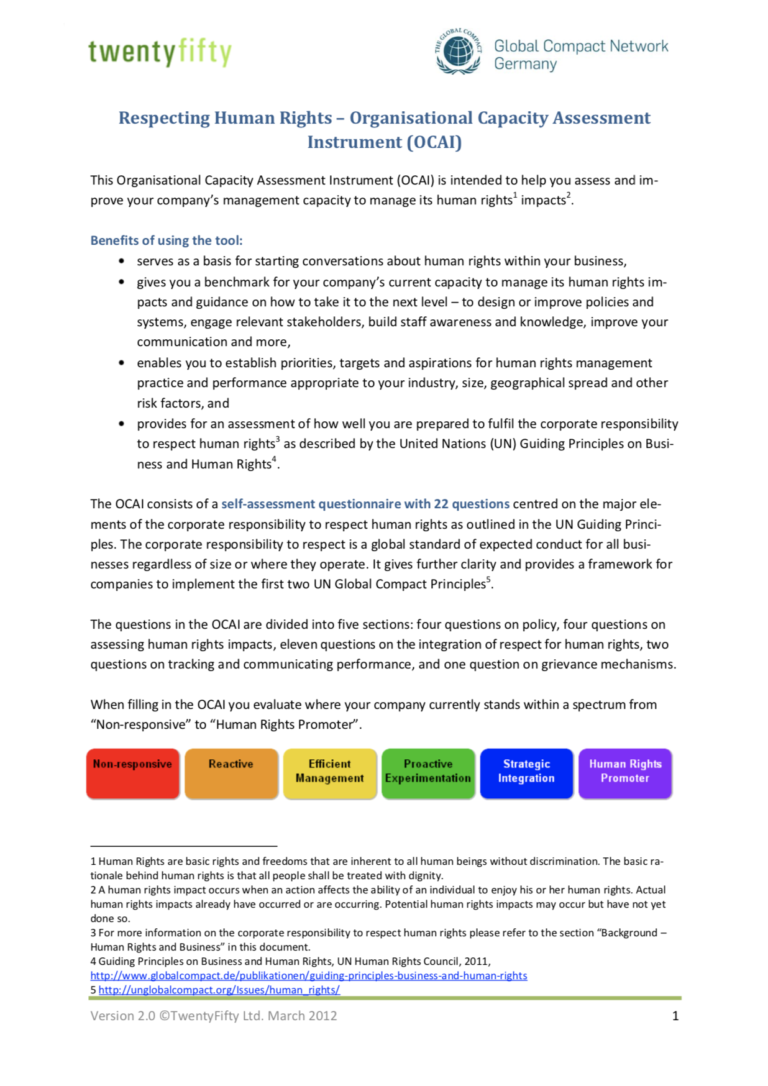
This Organisational Capacity Assessment Instrument (OCAI) is intended to help you assess and improve your company’s management capacity to manage its human rights impacts. The OCAI consists of a self-assessment questionnaire with 22 questions centered on the major elements of the corporate responsibility to respect human rights as outlined in the UN Guiding Principles. The corporate responsibility to respect is a global standard of expected conduct for all businesses regardless of size or where they operate. It gives further clarity and provides a framework for companies to implement the first two UN Global Compact Principles.

The questions and instructions are included in the PDF file attached below.

Respecting Human Rights – Organisational Capacity Assessment Instrument (OCAI) DOWNLOAD

post

page

attachment

revision

nav_menu_item

custom_css

customize_changeset

oembed_cache

user_request

wp_block

wp_template

wp_template_part

wp_global_styles

wp_navigation

wp_font_family

wp_font_face

acf-taxonomy

acf-post-type

acf-field-group

acf-field

ai1ec_event

exactmetrics_note

Code of conduct for foreign NGOs: Investigating human trafficking and child sexual exploitation & participating in rescues of victims
GuidancePublications

This document was created as an accompanying document to our “NGO Involvement in Raid/Rescue Operations” Webinar, which was held in May 2017. The webinar examined the risks and benefits, how to conduct better operations, as well as provided opti...Read More

Developing and Monitoring National Anti-Trafficking Response: A Practitioner’s Guide
Guidance

This Guide integrates ICMPD’s experience of advising and supporting governments in their anti-trafficking efforts in the past fifteen years from many other regions across the world – from Brazil to West Africa, Middle East and the Caucasus. It i...Read More

Undress Corruption – How to Prevent Corruption in The Readymade Garment Sector: Scenarios from Bangladesh
Guidance

The tragic event at Rana Plaza on April 24, 2013 drew the attention of the world to the conditions prevailing in the ready-made garment sector of Bangladesh. In its wake, over 150 European textile companies signed a legally binding agreement to main...Read More

Addressing Forced Labor and other Modern Slavery Risks: A Toolkit for Small and Medium-Sized Suppliers
GuidanceGraphics & Infographics

This toolkit aims to help companies that work in corporate supply chains to quickly identify areas of their business which carry the highest risk of modern slavery and develop a simple plan to prevent and address any identified risks. It is designed...Read More