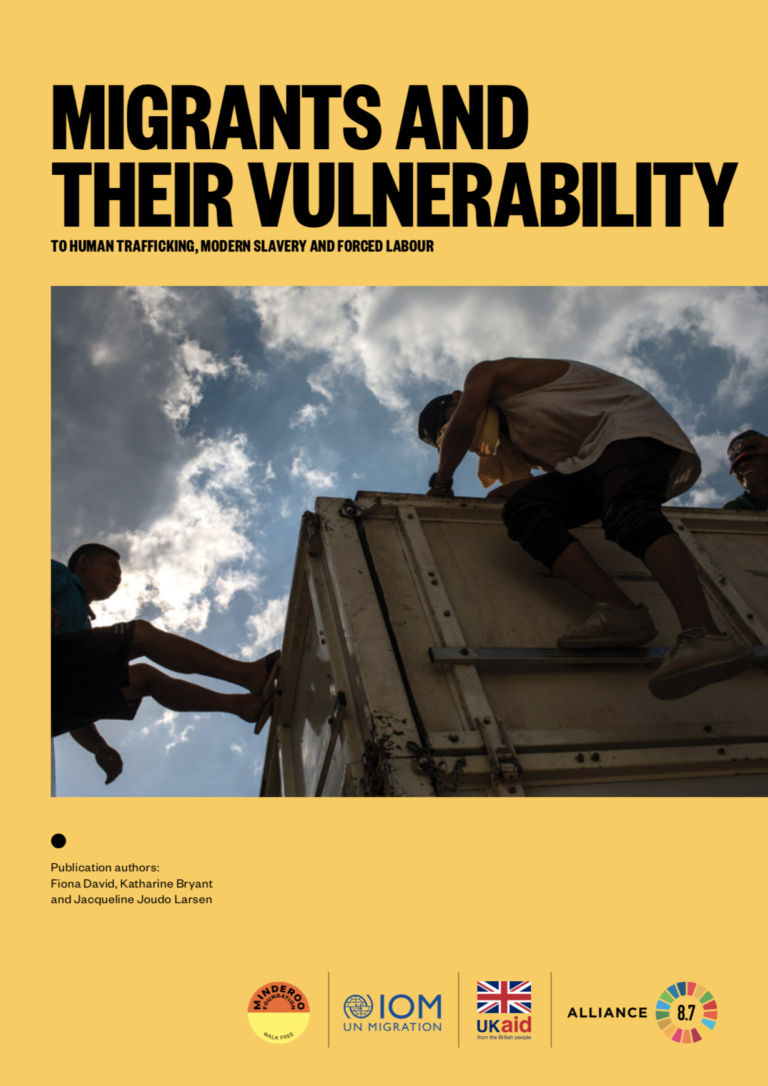
Research suggests connections exist between migration and criminal forms of exploitation such as human trafficking, forced labour and modern slavery. Certainly, constellations of risk are seen in certain migrant communities and migration corridors. However, it is not known how many of the world’s estimated 40 million victims of modern slavery are also migrants.

If we are to understand the relationship between migration and modern slavery, it is important that we know more about which migrants are vulnerable to modern slavery, as well as when and in what enabling circumstances.

Recognizing the importance of addressing modern slavery and specific vulnerabilities of migrants to modern slavery, this report has been prepared for the Alliance 8.7 Action Group on Migration to help to inform the activities of the group aimed at achieving SDG 8.7. The report examines the recent research literature on migration and modern slavery (published between 2014-2018) through a crime prevention lens, to identify a set of salient features that will help us better understand the relevant connections between migration and vulnerability to trafficking, forced labour, child labour, and modern slavery.
Migrants and Their Vulnerability to Human Trafficking, Modern Slavery and Forced Labour DOWNLOAD

post

page

attachment

revision

nav_menu_item

custom_css

customize_changeset

oembed_cache

user_request

wp_block

wp_template

wp_template_part

wp_global_styles

wp_navigation

wp_font_family

wp_font_face

acf-taxonomy

acf-post-type

acf-field-group

acf-field

ai1ec_event

exactmetrics_note

Nepal’s Human Trafficking Routes: Mapping destinations for migrant labour using collective data
Guidance

Nepal has a longstanding history of outward migration, predominantly resulting from a lack of economic opportunities at home. Migration for foreign employment, therefore, has become a lucrative industry, with families becoming heavily dependent on f...Read More

Local Government Guide– Illegal Massage Business Eradication Toolkit
Guidance

This toolkit examines key municipal provisions in the state of Texas (US), that target sex trafficking illicit massage businesses (IMBs), and outlines best practices for drafting a municipal ordinance, including purpose, scope, and penalty provision...Read More

Evidence from Japanese companies assessment on human rights due diligence
Guidance

The Human Rights Council unanimously endorsed the UN Guiding Principles on Business and Human Rights (UNGPs) in 2011. More than 10 years later, this global standard for how business should respect human rights has driven some positive change. While ...Read More

Business Banking and Start-up Support for Survivors of Modern Slavery and Human Trafficking
GuidanceGood Practices

In response to the issues raised in the Expert Review, although most fall outside of SII’s mandate, FAST hosted a global Survivor Business Roundtable on 27 June 2022 to gain more insight into survivors' needs regarding business banking and start-u...Read More

TAGS: Global