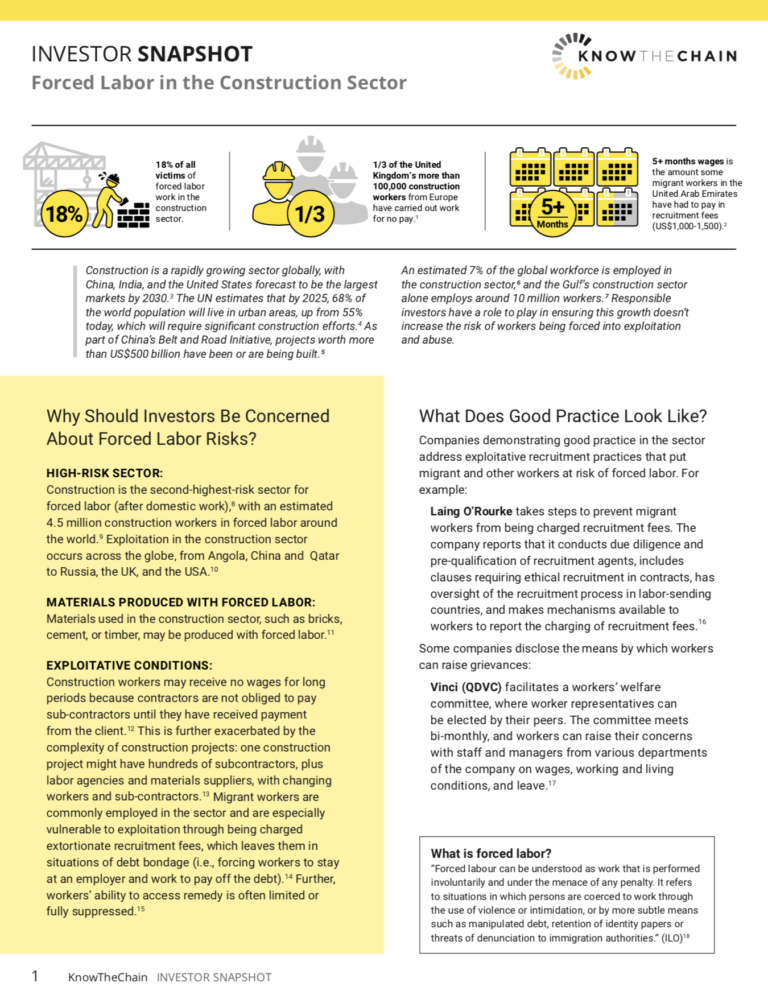
KnowTheChain’s Investor snapshot on Forced Labour in the Construction Sector highlights why investors should be concerned about forced labour risks in the construction sector, what the sector is doing to address these risks, and what action investors should be taking.

Construction is a rapidly growing sector globally, with China, India, and the United States forecast to be the largest markets by 2030. The UN estimates that by 2025, 68% of the world population will live in urban areas, up from 55% today, which will require significant construction efforts. As part of China’s Belt and Road Initiative, projects worth more than US$500 billion have been or are being built. 

An estimated 7% of the global workforce is employed in the construction sector, and the Gulf’s construction sector alone employs around 10 million workers. Responsible investors have a role to play in ensuring this growth doesn’t increase the risk of workers being forced into exploitation and abuse.

Forced Labour in the Construction Sector DOWNLOAD

post

page

attachment

revision

nav_menu_item

custom_css

customize_changeset

oembed_cache

user_request

wp_block

wp_template

wp_template_part

wp_global_styles

wp_navigation

wp_font_family

wp_font_face

acf-taxonomy

acf-post-type

acf-field-group

acf-field

ai1ec_event

exactmetrics_note

Public Procurement and Human Rights Due Diligence to Achieve Respect for Labour Rights Standards in Electronics Factories: A Case Study of the Swedish County Councils and the Dell Computer Corporation
Publications

A sector-specific case example ‘The Swedish County Councils’ in-depth review of the human rights policies and due diligence of its IT contractor, Atea, and subcontractor, Dell, to respect workers’ rights has helped increase both companies’ ca...Read More

Tracking Progress: Assessing Business Responses to Forced Labour and Human Trafficking in the Thai Seafood Industry
Publications

Thailand is the fourth-largest exporter of seafood globally. For over a decade, labour abuse, particularly of migrant workers from Myanmar, Cambodia, and Lao PDR, has been widely documented within the Thai seafood industry. Media exposés linking...Read More

From Evidence to Action: Challenges to Evidence Uptake and Impact
Publications

On 10-12 November 2020, the USAID Asia Counter-Trafficking in Persons project hosted the 2020 CTIP Evidence Summit, "From Evidence to Action", which included the two Summit discussions "Barriers to Evidence Uptake — Civil Society Organization (CSO...Read More

TAGS: Global
Human trafficking for labour exploitation: the results of a two-phase systematic review mapping the European evidence base and synthesising key scientific research evidence
Publications

Abstract Objectives The article objectives were (1) to systematically map the contours of the European evidence base on labour trafficking, identifying its key characteristics, coverage, gaps, strengths and weaknesses and (2) to synthesise key scie...Read More

TAGS: Europe