
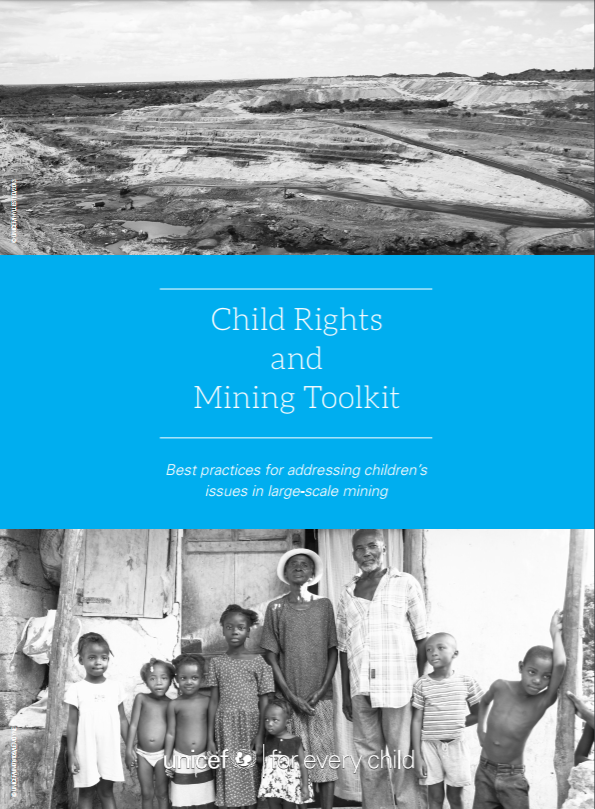
The Toolkit is designed to assist any of those in the mining sector who are responsible for designing and implementing strategies related to social and environmental performance at the project level. It provides 10 concise tools for improving social and environmental performance towards respecting and advancing children’s rights in the following areas:
1. Impact assessment
2. Stakeholder engagement
3. Resettlement
4. In-migration
5. Environment
6. Security
7. Health and safety
8. Working conditions
9. Protecting children from sexual violence
10. Social investment

The assessment conducted included children living or working on the street, orphans and child labourers.

post

page

attachment

revision

nav_menu_item

custom_css

customize_changeset

oembed_cache

user_request

wp_block

wp_template

wp_template_part

wp_global_styles

wp_navigation

wp_font_family

wp_font_face

acf-taxonomy

acf-post-type

acf-field-group

acf-field

ai1ec_event

exactmetrics_note

Financial Industry: Modern Slavery Awareness Survey
Publications

When asked the importance of the following social and environmental issues at a personal level, over four fifths (87%) of financial services employees rate modern slavery and human trafficking as important. ...Read More

Human rights impacts of Nordic investments in renewable energy developments in the Global South
Publications

The climate emergency poses a huge threat to human rights. In order to address the climate crisis, a transition to an economy respectful of the planet is urgently required. As part of this green transition, moving away from fossil energy sources, to...Read More

COVID-19 and Modern Slavery: A Research Response
COVID-19 resourcesPublications

COVID-19 represents a large and sudden exogenous shock to the world. The pandemic itself and the measures being undertaken to slow its pace and effect have short, medium, and long-term impacts on the problem of modern slavery. We have formulated res...Read More

Corporate Social Responsibility Review: Risks of Child Labor on Select Coffee Farms in Nicaragua
Publications

In Nicaragua, coffee is mainly produced on small-scale farms where temporary or seasonal work, weak remuneration, subcontracting, migrant workers, and child labor are likely to exist. In recent years, corporate social responsibility (CSR) activitie...Read More