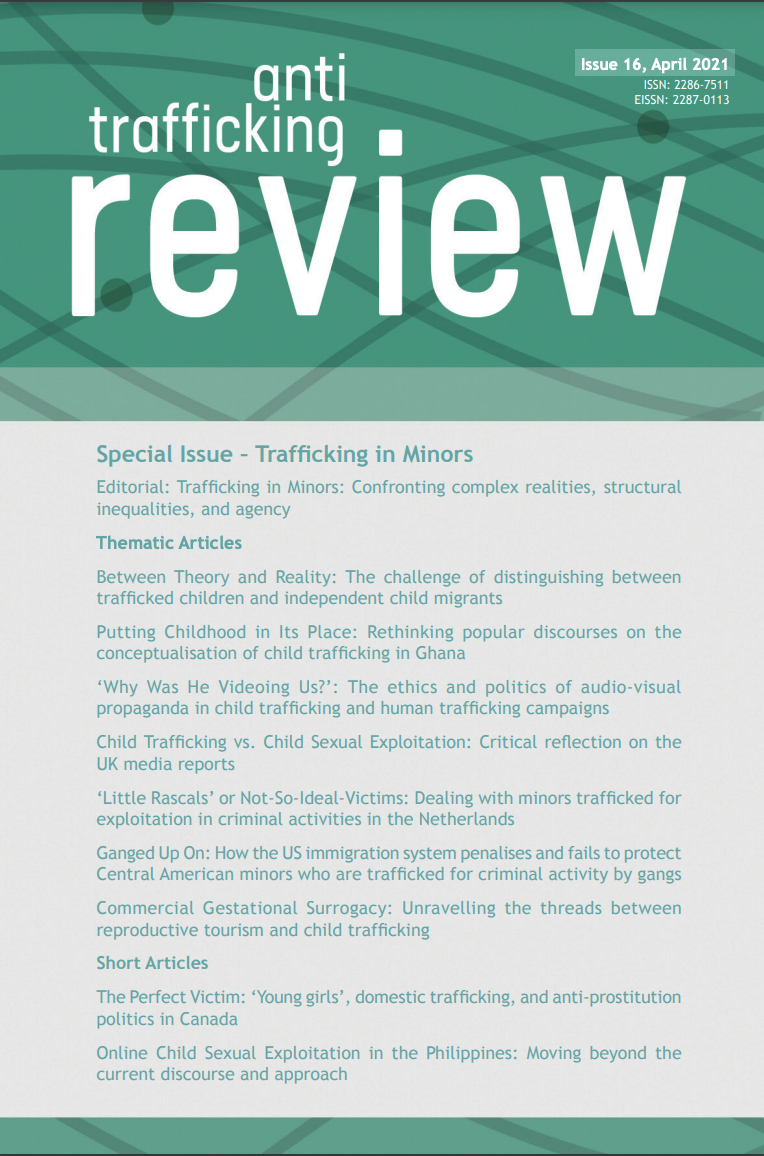
This Special Issue of Anti-Trafficking Review focuses on the phenomenon of trafficking in minors in different contexts and from a variety of perspectives. These include its relationship to child labour and adolescent migration, online sexual exploitation, and commercial gestational surrogacy, as well as lesser-known manifestations, such as trafficking of children for exploitation in criminal activities. Other contributions analyse media reports and NGO campaigns and interventions that aim to draw attention to the problem. Contributors emphasise that policies and interventions against child trafficking need to prioritise measures that address the underlying socio-economic and political root causes of the phenomenon – those related to development, access to education, healthcare, decent work, and migration regimes.

Special Issue - Trafficking in Minors - Anti-Trafficking Review, 2021 DOWNLOAD

post

page

attachment

revision

nav_menu_item

custom_css

customize_changeset

oembed_cache

user_request

wp_block

wp_template

wp_template_part

wp_global_styles

wp_navigation

wp_font_family

wp_font_face

acf-taxonomy

acf-post-type

acf-field-group

acf-field

ai1ec_event

exactmetrics_note

Human Trafficking & Native Peoples in Oregon: A Human Rights Reports
Publications

A report on human trafficking and native people in the state of Oregon, seeking to identify if federal, state, and local government protections are effective in addressing trafficking amongst this population. State,  Federal, and Tribal legislatio...Read More

Pirates and Slaves: How Overfishing in Thailand Fuels Human Trafficking and the Plundering of Our Oceans
GuidancePublications

This report calls for overfishing, pirate fishing and modern-day slavery in the Thai fishing industry to be addressed as interconnected issues. It examines the complex and multi-faceted problems in Thailand’s fisheries sector and offers recommenda...Read More

Knowledge of and access to frontline workers among poor, rural households in Amhara region, Ethiopia: a mixed-methods study
Publications

Social protection programmes have effectively reduced poverty and improved food security. However, the effects of poverty require an intersectoral approach to adequately address poor nutrition and health. Identifying gaps in knowledge and access to ...Read More

TAGS:
Impact of the CARE Tipping Point Program in Nepal on adolescent girls’ agency and risk of child, early, or forced marriage: Results from a cluster-randomized controlled trial
Publications

ackground: Girl child, early, and forced marriage (CEFM) persists in South Asia, with long-term effects on well- being. CARE’s Tipping Point Initiative (TPI) sought to address the gender norms and inequalities underlying CEFM by engaging part...Read More

TAGS: