
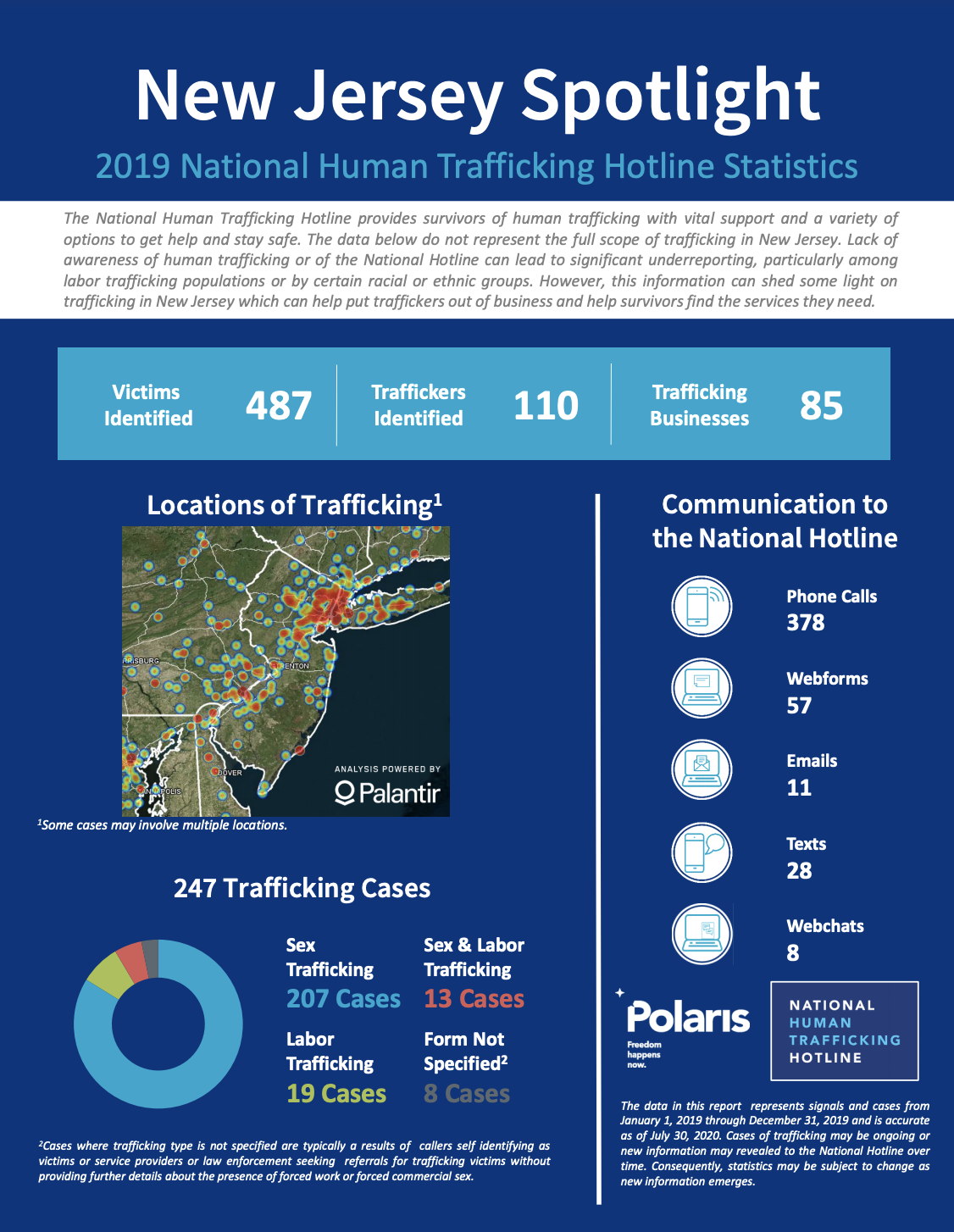
The data in this report represents signals and cases from January 1, 2019 through December 31, 2019 and is accurate as of July 30, 2020. Cases of trafficking may be ongoing or new information may revealed to the National Hotline over time. Consequently, statistics may be subject to change as new information emerges.

You can download the report infographic below.

National Hotline 2019 New Jersey State Report - National Human Trafficking Hotline, 2020 DOWNLOAD

post

page

attachment

revision

nav_menu_item

custom_css

customize_changeset

oembed_cache

user_request

wp_block

wp_template

wp_template_part

wp_global_styles

wp_navigation

wp_font_family

wp_font_face

acf-taxonomy

acf-post-type

acf-field-group

acf-field

ai1ec_event

exactmetrics_note

Looking for a Hidden Population: Trafficking of Migrant Laborers in San Diego County
Publications

Written by Sheldon X. Zhang, Ph.D., Principal Investigator. A study examining San Diego County's population of migrant farmworkers who have been trafficked.  This study examines the types of trafficking experienced and the condition faced by...Read More

Views and Needs of Young People in Serbia with Regard to Risks and Protection from Labor Exploitation
Publications

Within the Make It Work for Youth – MyWay project, implemented by NGO ASTRA – Anti Trafficking Action with support of the European Union (EIDHR program), 20 students were selected and trained to collect data, that is, to conduct a research and a...Read More

Corporate Social Responsibility Review: Risks of Child Labor on Select Coffee Farms in Nicaragua
Publications

In Nicaragua, coffee is mainly produced on small-scale farms where temporary or seasonal work, weak remuneration, subcontracting, migrant workers, and child labor are likely to exist. In recent years, corporate social responsibility (CSR) activitie...Read More

Supermarket Responsibilities for Supply Chain Workers’ Rights – Continuing Challenges in Seafood Supply Chains and the Case for Stronger Supermarket Action
Publications

International food supply chains provide employment for tens of millions of women and men around the world, demonstrating the potential for private sector actors to fight poverty and inequality. Yet far too many work in appalling conditions. The o...Read More